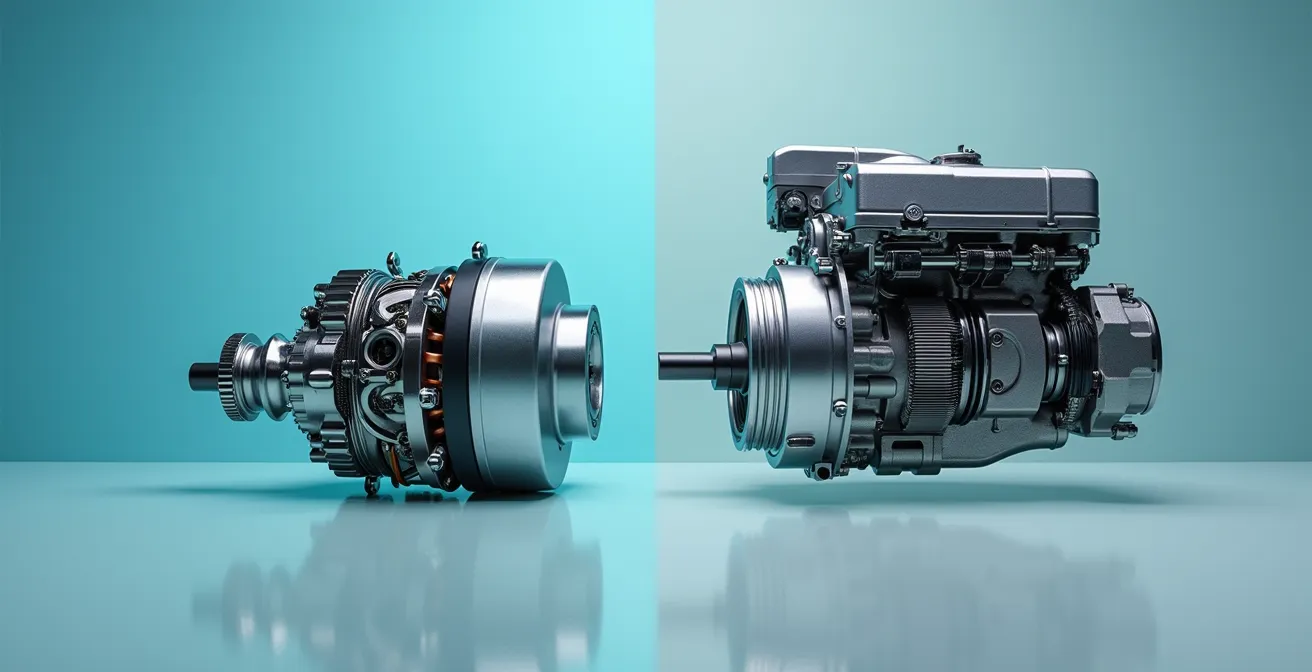
The lower maintenance cost of electric vehicles is not merely due to having fewer parts; it represents a fundamental paradigm shift from managing unpredictable mechanical wear to monitoring predictable electrical and thermal systems.
- Systemic simplicity drastically reduces the number of potential failure points compared to the complex interplay of mechanical, fluid, and thermal systems in an internal combustion engine (ICE).
- Maintenance evolves from a schedule-based, preventive model (oil changes, belt replacements) to a data-driven, predictive model based on sensor monitoring and state-of-health analysis.
Recommendation: Fleet managers should pivot their operational strategy from traditional mechanical inspections to implementing robust, sensor-based monitoring for thermal and electrical powertrain health to minimize total cost of ownership (TCO).
For any fleet manager, the words “unplanned downtime” translate directly into operational losses and escalating expenditures. The maintenance of an internal combustion engine (ICE) vehicle fleet is a complex, costly, and often reactive process. It’s a constant battle against friction, heat, and mechanical fatigue. The common refrain is that electric vehicles (EVs) require less maintenance because they have “fewer moving parts.” While true, this statement is a profound oversimplification. It fails to capture the fundamental engineering shift that makes EV powertrains inherently more reliable and transforms the entire maintenance philosophy.
The real difference lies not in the quantity of parts, but in their nature. An ICE is a controlled explosion machine, a chaotic environment of high pressures, extreme temperatures, and dozens of interconnected mechanical systems that wear out in ways that are difficult to predict. The EV powertrain, by contrast, is a solid-state, electronically controlled system governed by the elegant principles of electromagnetism. This transition from a mechanical-first to an electrical-first architecture changes everything about how we approach vehicle reliability and operational readiness.
But if the core advantage is this systemic simplicity, how does it translate into tangible benefits for a fleet’s bottom line? The key is understanding that we are moving away from a world of grease, oil, and filters to one of sensors, software, and thermal management. The maintenance focus shifts from reacting to mechanical failures to proactively monitoring the state of health of electrical components. This isn’t just a minor improvement; it’s a strategic overhaul of asset management.
This analysis will deconstruct the engineering principles that underpin the superior reliability of EV powertrains. We will move beyond surface-level comparisons and delve into the physics of electric motors, the critical role of predictive maintenance, the impact of powertrain configuration on durability, and the thermal challenges that represent the new frontier of vehicle maintenance. This is the technical deep dive for managers looking to reduce OPEX not by chance, but by design.
To fully grasp the operational advantages of electric powertrains, this article breaks down the key engineering differences and their direct impact on maintenance strategy. The following sections provide a structured analysis for fleet managers focused on reliability and cost reduction.
Summary: The Engineering Case for Lower EV Maintenance
- Why Electric Motors Deliver Peak Torque at Zero RPM?
- How to Detect Powertrain Issues Without the Noise of an Engine?
- RWD or AWD: Which Powertrain Configuration Offers Better Range Efficiency?
- The Cooling Failure Error That Leads to Battery Fires
- How to Drive With One Pedal to Extend Brake Pad Life by 50%?
- Why Unplanned Downtime Costs 10x More Than Preventive Sensor Installation?
- The Cryogenic Constraint That Keeps Quantum Computers Out of Offices
- How to Maximize Battery Autonomy in Cold Weather Conditions?
Why Electric Motors Deliver Peak Torque at Zero RPM?
The fundamental difference in maintenance originates in the physics of torque production. An internal combustion engine is an inefficient heat engine that must build rotational speed (RPM) to generate peak torque. This process involves hundreds of moving parts—pistons, crankshafts, valves, camshafts—all subject to immense mechanical stress, friction, and wear. By contrast, an electric motor operates on the principle of electromagnetism. When current is applied to the stator windings, it creates a rotating magnetic field that interacts with the rotor, generating immediate rotational force. This means 100% of the motor’s torque is available from 0 RPM.
This “instant torque” isn’t just a performance benefit; it is a direct result of profound systemic simplicity. The motor has essentially one major moving part: the rotor. There is no metal-on-metal friction generating wear particles that contaminate fluids. This superior design is reflected in its energy efficiency; while ICEs struggle to convert 20-30% of fuel energy into motion, modern EVs convert between 85-90% of electrical energy into forward momentum. Less wasted energy means less heat and less stress on components.
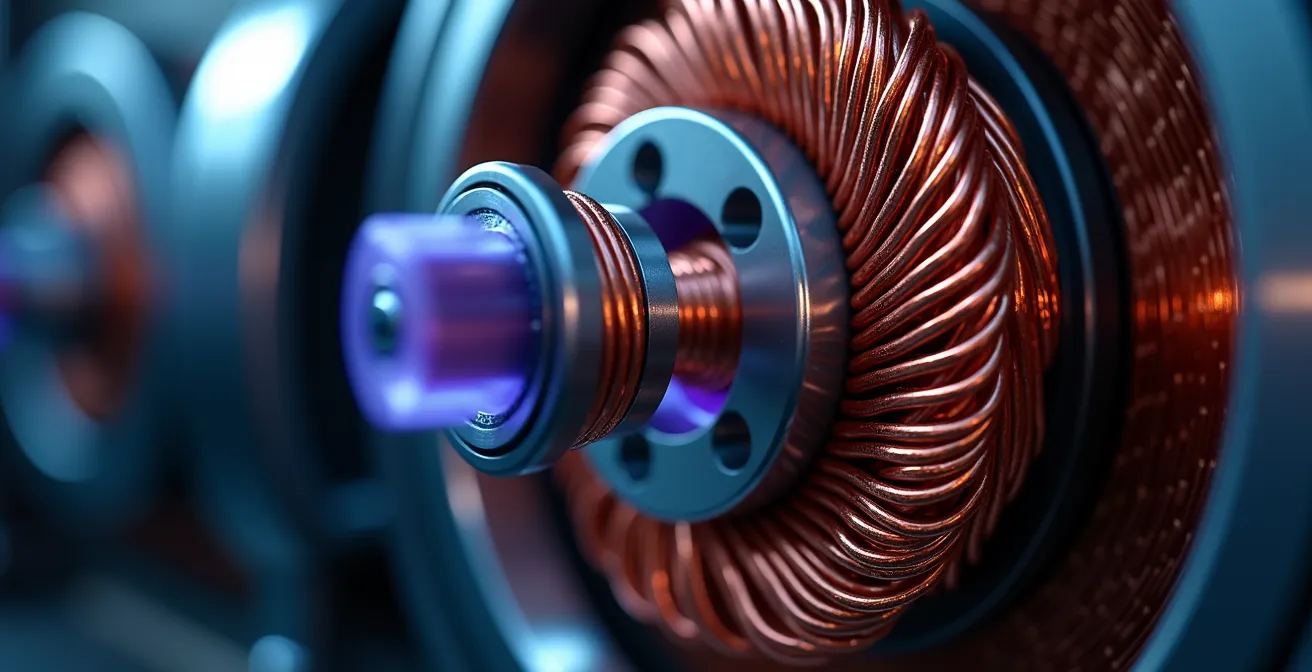
This inherent durability means the electric motor itself is rarely a point of failure. It doesn’t require oil changes, spark plug replacements, or timing belt services. In fact, the operational lifespan is an order of magnitude greater than that of an ICE. According to industry analyses, electric motors are designed to last for hundreds of thousands of miles, with some manufacturers aiming for designs that can exceed a million miles with minimal servicing. This moves the motor from a frequent maintenance item to a fit-and-forget component for the majority of the vehicle’s life.
How to Detect Powertrain Issues Without the Noise of an Engine?
In an ICE vehicle, experienced technicians often diagnose issues by sound—a knocking rod, a whining belt, or a sputtering exhaust. The near-silent operation of an EV powertrain removes this auditory feedback loop, but replaces it with something far more powerful: data. Detecting powertrain issues in an EV is not an art; it is a science, relying on a network of sensors that monitor the system’s state of health in real-time. This ushers in the era of predictive maintenance, a proactive strategy that identifies potential failures before they occur.
Instead of listening for anomalies, maintenance systems monitor for deviations in data streams. Key parameters include motor temperature, inverter voltage fluctuations, current draw, and high-frequency vibrations that are imperceptible to humans but indicative of bearing wear or rotor imbalance. This data-centric approach is fundamentally more reliable than relying on human senses. It allows fleet managers to schedule maintenance based on actual component health rather than arbitrary mileage intervals, drastically reducing unnecessary service and preventing catastrophic failures.
95% of predictive maintenance adopters report positive ROI, with 27% achieving full amortization within just one year
– Industry Studies, WorkTrek Predictive Maintenance Trends Report
The market’s shift towards this strategy is undeniable. For fleet managers, this means the technician’s new essential tool is a diagnostic laptop, not a wrench. The ability to interpret sensor data and act on predictive alerts becomes the core skill for maintaining fleet uptime. The global predictive maintenance market is experiencing unprecedented growth, projected to surge from $10.93 billion in 2024 to $70.73 billion by 2032, demonstrating its critical importance in modern industrial and fleet operations.
RWD or AWD: Which Powertrain Configuration Offers Better Range Efficiency?
While range efficiency is a critical factor, fleet managers must also evaluate powertrain configuration through the lens of reliability and maintenance. A single-motor Rear-Wheel Drive (RWD) setup embodies simplicity, while a dual-motor All-Wheel Drive (AWD) system introduces complexity in exchange for performance and redundancy. From a pure maintenance perspective, fewer components typically mean fewer failure points. However, the operational context matters. The overall reliability of EVs already far surpasses ICE vehicles; a German study found that the key data shows 4.2 failures for 1,000 EVs compared to 10.2 for gasoline/diesel cars.
The choice between RWD and AWD becomes a trade-off between concentrated wear and distributed load. In a single-motor RWD system, that one motor bears 100% of the propulsive stress. In a dual-motor AWD system, the load is split, reducing the strain on each individual motor and potentially extending their operational lifespan. This also provides a critical layer of “limp-home” redundancy—if one motor fails, the other can still provide propulsion, preventing a vehicle from being stranded and turning a catastrophic failure into a manageable service event.
The following table breaks down the reliability implications from an engineering standpoint, helping to frame the decision beyond just initial cost and range metrics.
| Configuration | Load Distribution | Redundancy | Maintenance Impact |
|---|---|---|---|
| Single Motor RWD | 100% load on one motor | No backup propulsion | Higher wear concentration |
| Dual Motor AWD | Load split between motors | Limp-home capability if one fails | Reduced individual motor stress |
For fleets operating in critical response roles or in harsh conditions where being stranded is not an option, the added cost of an AWD system can be justified as an insurance policy against downtime. For standard-duty urban fleets, the ultimate simplicity and lower upfront cost of an RWD configuration may present a more compelling TCO argument, especially given the high intrinsic reliability of the motor itself.
The Cooling Failure Error That Leads to Battery Fires
If the electric motor is a paragon of reliability, the battery pack and its associated thermal management system represent the new critical frontier of maintenance. Unlike an ICE, where heat is a byproduct to be expelled, an EV’s battery operates within a narrow optimal temperature window. A failure in the cooling system—whether it’s a pump malfunction, a coolant leak, or a blocked radiator—is not a minor issue. It can lead to a dangerous condition known as thermal runaway, where a cascading failure of battery cells causes an uncontrollable release of energy and, potentially, fire.
This makes the thermal management system the single most important maintenance checkpoint on an EV. It is a sealed, sophisticated network of pumps, chillers, and coolant lines that must be monitored with the same diligence previously reserved for an engine’s oil and timing belt. Any error code related to cooling performance cannot be ignored. The financial consequences of such a failure extend far beyond the cost of the vehicle. According to industry data, industrial manufacturers lose $50 billion annually to unplanned downtime, with median costs often exceeding $125,000 per hour. A vehicle fire due to a cooling failure represents the ultimate form of unplanned downtime.
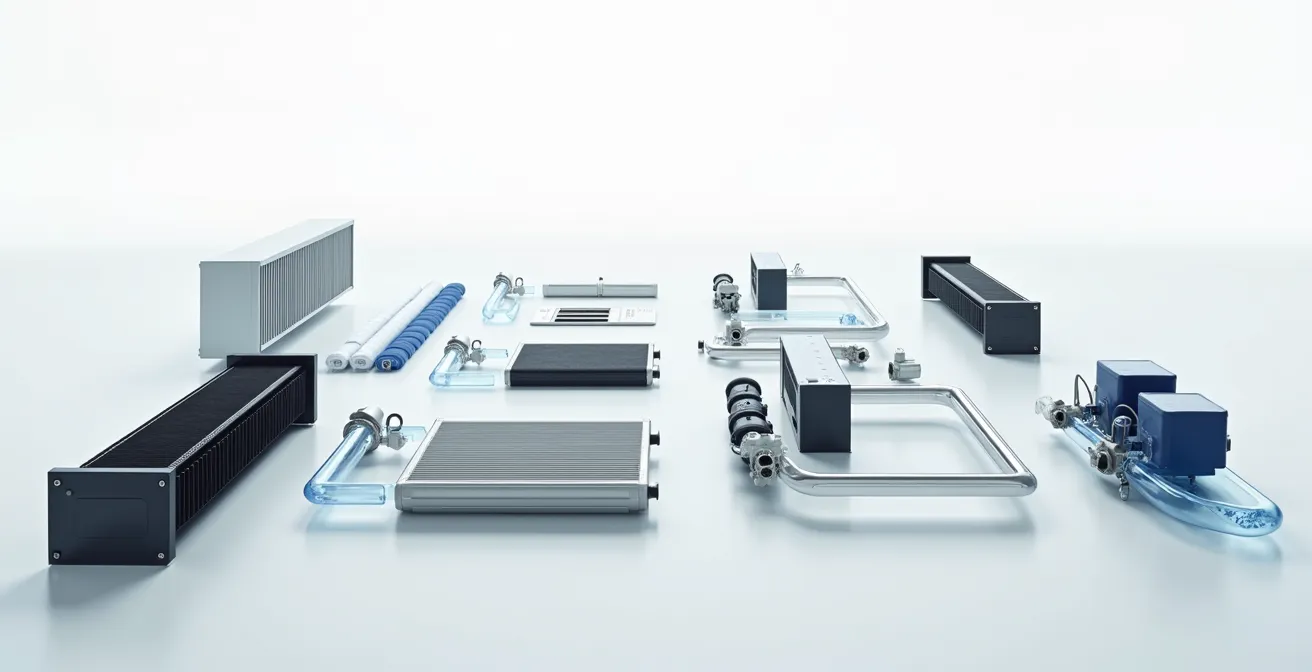
Therefore, a fleet’s maintenance protocol must pivot to prioritize the health of this system. This includes regular checks of coolant levels and quality (where accessible), monitoring sensor data for any anomalies in pump pressure or temperature differentials, and immediate action on any diagnostic trouble codes (DTCs) related to the thermal loop. The maintenance paradigm shifts from managing mechanical wear to mitigating thermal risk.
How to Drive With One Pedal to Extend Brake Pad Life by 50%?
One of the most significant maintenance advantages of an EV is the dramatic reduction in brake wear, achieved through regenerative braking. When the driver lifts off the accelerator, the electric motor reverses its function, acting as a generator. It converts the vehicle’s kinetic energy back into electrical energy to recharge the battery. This process creates drag, slowing the vehicle down without ever engaging the physical friction brakes. Mastering this “one-pedal driving” technique can extend the life of brake pads and rotors by 50% or more, significantly lowering consumable costs.
However, this reduced reliance on friction brakes introduces a new maintenance consideration: seizure and corrosion. Because the brake calipers and pads are used so infrequently, they are susceptible to rust and seizing, especially in wet or salted-road environments. A seized caliper can cause continuous drag, ironically reducing efficiency and causing premature, uneven wear. Therefore, EV maintenance schedules must include periodic, firm applications of the friction brakes to keep the components clean and moving freely. It’s a counter-intuitive but critical practice.
The efficiency of the motor as both a propulsion device and a generator is governed by its load. Engineering principles show that motor efficiency is highest near its rated load (75–100%), with significant drops below 50% load. Maximizing one-pedal driving involves anticipating stops and coasting to allow the motor to operate in its most efficient regenerative range, turning what would be wasted heat in an ICE into usable range in an EV.
Action Plan: Optimizing Regenerative Braking and Brake Health
- Set the regenerative braking level appropriately for driving conditions—higher for stop-and-go city traffic, lower for smooth highway driving.
- Periodically use the friction brakes firmly (in a safe, controlled manner) to prevent caliper seizure and clear corrosion from rotor surfaces.
- Monitor brake pad thickness during regular inspections; despite reduced wear, they are not lifetime components and still require checks.
- Adjust driving style to maximize regenerative efficiency by anticipating stops far in advance, allowing for long, gentle deceleration.
- Check and replace brake fluid according to the manufacturer’s schedule (typically every 2-3 years), as it is hygroscopic and its quality degrades over time regardless of brake usage.
Why Unplanned Downtime Costs 10x More Than Preventive Sensor Installation?
The core argument for an EV-centric fleet, from a financial perspective, is the dramatic reduction in Total Cost of Ownership (TCO), driven primarily by lower maintenance and “fuel” costs. However, the most significant, yet often hidden, cost of any fleet is unplanned downtime. A vehicle undergoing reactive maintenance is not just incurring repair costs; it is generating zero revenue and disrupting logistics. The shift to a predictive maintenance model, enabled by the inherent sensor-rich nature of EV powertrains, directly attacks this cost center.
Preventive sensor installation and the accompanying monitoring software are an upfront investment, but this cost is dwarfed by the expense of a single catastrophic failure. The business case is not about if this investment pays off, but how quickly. Technologies like Digital Twins—virtual models of a physical asset updated with real-time sensor data—allow managers to simulate stress and predict failures with remarkable accuracy. As GE Digital estimates, this technology alone could cut equipment downtime by 30% across industries. For a vehicle fleet, that translates directly to more vehicles on the road, generating revenue.
Case Study: Automotive Manufacturer’s Maintenance Cost Reduction
The real-world impact of this strategy is well-documented. A global automotive manufacturing plant implemented a comprehensive predictive maintenance and Digital Twin strategy for its own factory equipment. The result was a verifiable 30% reduction in maintenance costs and a significant decrease in production line stoppages. This same principle applies directly to managing a fleet of vehicles, where each vehicle is a mobile production asset.
For fleet managers, the math is simple. The cost of outfitting a vehicle with enhanced sensors and monitoring software is a predictable, one-time capital expenditure (CAPEX). The cost of a tow truck, emergency repairs, and a day of lost service is an unpredictable and recurring operational expenditure (OPEX). The former is an investment in reliability; the latter is the price of failing to do so.
The Cryogenic Constraint That Keeps Quantum Computers Out of Offices
In the world of high-performance computing, the primary barrier to bringing the immense power of quantum computers into mainstream use is thermal management. These machines require cryogenic temperatures, close to absolute zero, to function. Any deviation, any excess heat, destroys their delicate quantum state. This serves as a powerful analogy for the modern EV powertrain: while not requiring cryogenic temperatures, its long-term reliability and efficiency are fundamentally dictated by how effectively it manages heat.
In an electric motor and its power electronics, heat is the principal enemy of efficiency and longevity. It is the primary factor that accelerates the degradation of component insulation, demagnetizes the rotor’s permanent magnets, and increases electrical resistance in the copper windings. This isn’t a minor effect; it directly impacts the vehicle’s performance and OPEX.
Heat is a significant hindrance to efficiency. Winding resistance increases with temperature, raising copper losses. Magnetic materials also lose performance when overheated
– Electricity Forum, Electric Motor Efficiency Guide
Just as the sound of a knocking engine signaled trouble in an ICE, an alert from a thermal sensor is the modern equivalent for an EV. The entire maintenance philosophy pivots from managing mechanical friction to managing thermal loads. This involves ensuring the integrity of the cooling system, monitoring the performance of inverters and converters, and analyzing data for any signs of components operating outside their optimal temperature range.

This focus on thermal precision is what separates a well-maintained, reliable EV fleet from one plagued by premature component failures and reduced range. The “cryogenic constraint” of quantum computing highlights a universal engineering truth: control over the thermal environment is paramount for the reliability of any advanced electrical system.
Key Takeaways
- The reliability of EVs stems from systemic simplicity and the physics of electromagnetism, not just a lower parts count.
- EV maintenance is a predictive, data-driven process focused on sensor monitoring, contrasting with the reactive, mechanical nature of ICE service.
- Thermal management is the most critical maintenance focus area for an EV, directly impacting the safety and longevity of the battery and power electronics.
How to Maximize Battery Autonomy in Cold Weather Conditions?
While EV powertrains are mechanically robust, their energy source—the lithium-ion battery—is sensitive to ambient temperature. Cold weather is the primary adversary of battery autonomy. Low temperatures slow down the electrochemical reactions inside the battery, reducing its ability to discharge power effectively and increasing internal resistance. This can result in a temporary but significant reduction in range, a major concern for fleet operations in colder climates. However, proactive management can mitigate a large portion of this impact.
The most effective tool is battery preconditioning. This feature uses energy from the grid (while the vehicle is plugged in) to warm the battery up to its optimal operating temperature *before* the vehicle is driven. Setting a departure time in the vehicle’s app allows the system to automatically manage this process. This not only preserves the vehicle’s state of charge for driving but also ensures maximum power and regenerative braking performance are available from the start. Leaving a vehicle unplugged in freezing temperatures and driving off immediately is the least efficient way to operate.
Beyond preconditioning, other operational strategies can help preserve range and battery health in the cold:
- When possible, park the vehicle in a covered or insulated garage to minimize the temperature drop the battery experiences.
- Utilize the vehicle’s “Eco” or “Range” modes, which typically optimize the climate control system and moderate acceleration to conserve energy.
- If leaving the vehicle for an extended period (weeks), it is best to leave it with a 50-60% state of charge and, if possible, plugged into a slow (Level 1 or 2) charger to allow the battery management system to maintain its health.
- When starting a journey, set the cabin preconditioning via the app at least 20 minutes before departure to ensure the cabin is warm and windows are defrosted using grid power, not battery power.
Ultimately, managing an EV fleet in the cold reinforces the central theme: proactive, data-informed management yields far better results than reactive operation. Understanding and utilizing the vehicle’s built-in thermal management tools is key to maintaining operational efficiency year-round.
To truly leverage these advantages and minimize operational expenditures, the next step for any fleet is to develop a comprehensive predictive maintenance strategy based on real-time powertrain data and thermal health monitoring.
Frequently asked questions on Why EV Powertrains Require Less Maintenance Than Combustion Engines?
What is battery preconditioning?
While your vehicle is plugged in, you can prepare your battery, cabin, and even your steering wheel, to optimize your comfort and your vehicle’s performance. This uses grid power to bring the battery to its ideal operating temperature before you start driving, preserving range.
Should I charge to 100% in winter?
For daily use, a 90% charge level is generally recommended for Nickel Cobalt Manganese (NCM) batteries, which are common in many EVs. Charging to 100% should be reserved for long trips. This practice helps to maximize the long-term health and lifespan of the battery pack.