In summary:
- Winter range loss is not a defect but a predictable result of battery chemistry; the cold increases internal resistance and forces the car to use energy for heating itself.
- Pre-heating your battery *while plugged in* is the single most effective way to preserve range, as it uses grid power for the most energy-intensive task.
- Ignore the car’s initial range estimate on a cold day. Instead, use real-time consumption (kWh/100km or mi/kWh) to calculate your true, predictable range after the first 15-20 minutes of driving.
- Adopt a “defensive” trip planning strategy: build in a 25-30% range buffer and prioritize high-speed (150kW+) charging stations, even if they are slightly off-route.
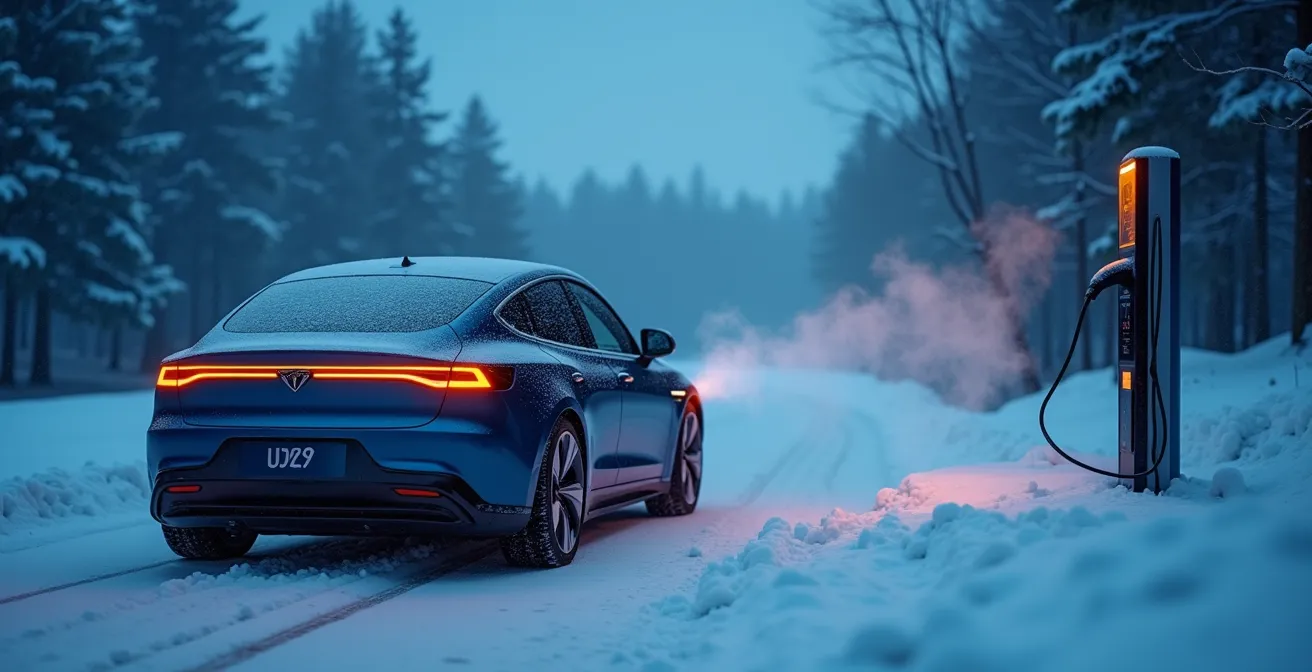
That sinking feeling of watching your electric vehicle’s range estimate plummet on the first truly cold morning is a shared frustration for many drivers in northern climates. Suddenly, a car that promised 300 miles of range struggles to deliver 200. The common advice is often generic: drive slower, moderate the heating, and use the heated seats. While these tips have merit, they only address the symptoms and fail to tackle the root cause of the anxiety: the unpredictability of winter driving.
But what if the key wasn’t just about *using* less energy, but understanding where it’s being *reallocated*? The real battle is against physics—specifically, the increased internal resistance of the battery and the significant energy consumed by its own thermal management system just to stay operational. The range you see disappearing isn’t just vanishing; it’s being actively used to protect the very heart of your vehicle from the cold. This is not a flaw, but a feature of lithium-ion chemistry that can be managed with the right knowledge.
This guide moves beyond simple tips to empower you with an expert’s understanding of your EV’s energy budget in winter. We will demystify why your battery’s performance changes, provide a concrete framework for pre-conditioning and trip planning, and show you how to shift from range anxiety to range confidence. By understanding the “why” behind the numbers, you can take proactive control and master your EV’s performance, no matter how low the temperature drops.
To help you navigate these concepts, this article is structured to build your expertise step-by-step. The following sections will guide you from the fundamental science of battery chemistry in the cold to advanced strategies for long-distance winter road trips.
Summary: Mastering Your EV’s Performance in Freezing Temperatures
- Why Lithium-Ion Batteries Lose 30% Capacity Below Freezing?
- How to Pre-Heat Your Battery While Plugged In to Preserve Range?
- WLTP or Real World: Which Range Estimate Should You Trust on the Highway?
- The “Deep Discharge” Mistake That Permanently Damages Battery Health
- When to Charge to 100%: The Rules for LFP vs. NMC Chemistries
- How to Combine Charging With Bio-Breaks to Lose Zero Travel Time?
- The Q4 Mistake: Why Blowing Your Budget in December Is Inefficient for B2B
- How to Plan Fast-Charging Stops for Trips Over 500km?
Why Lithium-Ion Batteries Lose 30% Capacity Below Freezing?
Lithium-ion batteries lose significant effective capacity in freezing temperatures primarily because the cold slows down the electrochemical reactions inside. Think of the liquid electrolyte inside the battery cells as becoming more viscous, like honey in a refrigerator. This slowdown dramatically increases the battery’s internal resistance, making it much harder for lithium ions to move between the anode and cathode. Consequently, the battery can’t discharge energy as efficiently or accept it as quickly during regenerative braking.
To combat this, your vehicle’s Battery Management System (BMS) activates a thermal management system. This is essentially an electric heater dedicated to warming the battery pack to its optimal operating temperature (typically around 20-25°C or 70-77°F). This self-heating process is not optional; it’s a critical safety measure to prevent permanent damage. However, it consumes a significant amount of energy directly from the high-voltage battery—energy that is therefore not available for propulsion. This “hidden” consumption is a major reason for the initial, sharp drop in range you see on a cold start.
The real-world impact is substantial. In fact, U.S. Department of Energy testing confirms that a battery can see a 30% range drop at 15°F with heavy heater use. This reduction is a combination of lower battery efficiency and the energy diverted to both battery and cabin heating. The BMS also intelligently restricts performance when the pack is cold, limiting acceleration and the effectiveness of regenerative braking to prevent a phenomenon called lithium plating, which can cause irreversible damage.
Understanding this dual challenge—reduced efficiency and active energy consumption for heating—is the first step toward mastering winter EV driving. The range loss isn’t a mystery, but a predictable cost of doing battle with thermodynamics.
How to Pre-Heat Your Battery While Plugged In to Preserve Range?
The single most effective strategy to mitigate winter range loss is to perform the battery’s warm-up using power from the grid, not from the battery itself. This is known as pre-conditioning or pre-heating. When your EV is plugged into a charger (even a standard Level 1 or 2 home charger), you can typically schedule a departure time or manually initiate pre-conditioning through the vehicle’s mobile app or infotainment system. This process does two things simultaneously: it warms the cabin to a comfortable temperature and, more importantly, it brings the high-voltage battery up to its optimal temperature.
By doing this while connected to an external power source, you start your journey with a fully charged *and* fully capable battery. The heavy lifting of overcoming the battery’s cold-induced internal resistance has already been done using grid electricity. This means nearly all of your battery’s stored energy is available for driving, rather than being immediately diverted to its own thermal management system. The difference in available range can be dramatic.
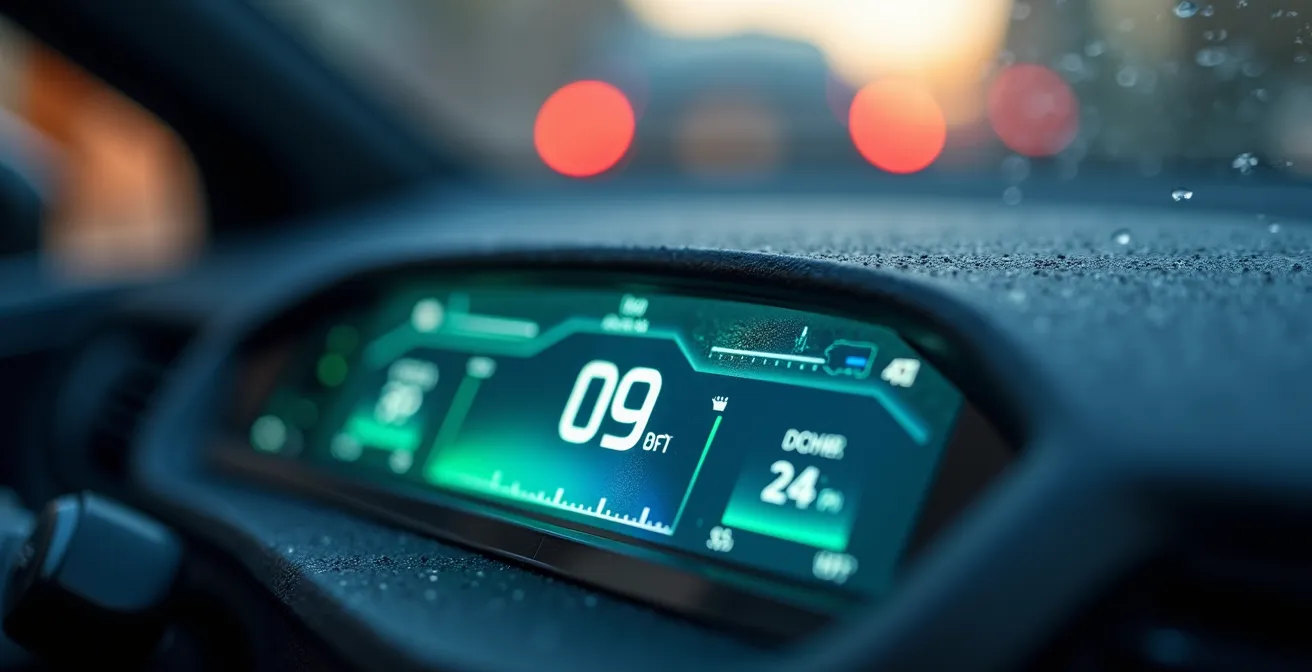
The visual feedback on your dashboard or app often indicates this process is active, showing that the car is drawing power to prepare itself. This isn’t just about comfort; it’s about optimizing the entire powertrain for efficiency from the moment you unplug. A warm battery can deliver more power, accept more energy from regenerative braking, and will provide a much more accurate initial range estimate.
To understand the concrete benefits, a comparative analysis from the Department of Energy shows a clear correlation between pre-conditioning time and the range preserved. The colder it is outside, the longer the pre-conditioning time required, but the greater the reward.
| Outside Temperature | Pre-conditioning Time | Energy Used from Grid | Range Benefit |
|---|---|---|---|
| -5°C (23°F) | 30 minutes | 2-3 kWh | +10-15% range |
| -10°C (14°F) | 45 minutes | 3-4 kWh | +15-20% range |
| -15°C (5°F) | 60 minutes | 4-5 kWh | +20-25% range |
Think of it as an athlete warming up before a race. You wouldn’t expect peak performance without preparation, and the same logic applies to your EV’s battery in the cold.
WLTP or Real World: Which Range Estimate Should You Trust on the Highway?
On a cold day, you should trust neither the official WLTP/EPA range nor your car’s initial “guess-o-meter” estimate. Standardized range tests are conducted in mild temperatures (around 20-25°C), and your car’s dashboard computer initially calculates its range based on ideal, warm-battery conditions. This is why the displayed miles can seem to evaporate in the first 15-20 minutes of a winter drive as the car grapples with the reality of a cold battery and the energy demand of its heaters.
This discrepancy, while alarming, is perfectly normal. It’s a sign that the car’s thermal management system is working as intended. As the Midtronics Technical Team notes in their expert analysis, this is an expected behavior:
A 30% range drop on a 15°F morning with heavy heater use is perfectly expected. What’s not normal is sudden, dramatic range loss that doesn’t correlate with temperature.
– Midtronics Technical Team, Winter Range Loss Analysis
Instead of relying on the estimated range, the educated EV driver should use a simple mental math framework based on real-time efficiency. Once your battery and cabin have warmed up (reaching a “range plateau”), your car’s efficiency reading (in kWh/100km or mi/kWh) becomes a highly reliable metric. You can calculate your real-world range with this formula:
- Start with your vehicle’s typical summer highway range as baseline.
- For every 10°C drop below 20°C, subtract 10-15% from that baseline range.
- Add an additional 5-10% penalty if you are using winter tires.
- Ignore the car’s estimated range for the first 15-20 minutes of a cold trip.
- Calculate your true, real-time range using the formula: (Usable Battery kWh) / (Current kWh/100km) × 100.
Your Winter Performance Audit Checklist: Establish a Personal Baseline
- Points of contact: On a cold day (below freezing), note your car’s initial range estimate and battery percentage before starting.
- Collecte: After driving 15-20 minutes on the highway, record the new range estimate, battery percentage, and the average energy consumption (kWh/100km or mi/kWh).
- Cohérence: Compare the actual percentage of battery used to the initial range drop. Does the car’s estimate match the real-world consumption? (e.g., did the range drop by 50 miles but you only used 10% of a 77kWh battery?).
- Mémorabilité/émotion: Note the difference between your real-time calculated range (using the efficiency metric) and the car’s displayed range. The real-time calculation is your new source of truth.
- Plan d’intégration: Use this personalized efficiency number (e.g., 25 kWh/100km) as your new baseline for planning all future winter trips in similar conditions.
This approach transforms you from a passive passenger, anxious about a fluctuating number, into an informed pilot managing a predictable energy budget.
The “Deep Discharge” Mistake That Permanently Damages Battery Health
While most EV drivers worry about running out of charge on the road, a far more insidious danger to battery health in winter is the “cold soak.” This phenomenon occurs when a battery with a very low state of charge (SoC) is left parked for an extended period in sub-zero temperatures. This is significantly more damaging than simply hitting 0% while driving.
When the battery is cold and has very little energy, its internal voltage drops. If you then try to charge it or draw a large amount of power (like starting the car and its heaters), the BMS can be forced to operate outside its safe parameters. The most significant risk here is irreversible lithium plating. Instead of properly inserting themselves into the anode’s graphite structure (intercalation), the lithium ions build up on the anode’s surface as metallic lithium deposits. This process permanently reduces the battery’s total capacity and its ability to accept a fast charge.
Case Study: The Cold Soak Phenomenon and Lithium Plating Risk
A comprehensive analysis of thousands of EVs by Recurrent Auto revealed a critical insight. Their data showed that the real danger isn’t hitting a 0% state of charge during a trip, but rather the scenario of letting a battery with under 20% SoC sit for many hours in freezing temperatures. This “Cold Soak” condition creates the perfect electrochemical environment for lithium plating to occur when the car is next started or plugged in. These metallic deposits act like blockages, permanently reducing the battery’s ability to store and deliver energy, and can also increase the risk of internal short circuits in extreme cases.
The cardinal rule for winter is to never leave your EV parked overnight in freezing conditions with a very low battery. Always aim to keep the SoC above 20%, ensuring the BMS has enough energy to protect itself if necessary.
When to Charge to 100%: The Rules for LFP vs. NMC Chemistries
The conventional wisdom of only charging an EV to 80% for daily use to preserve battery health is sound advice, but it primarily applies to vehicles with NMC (Nickel Manganese Cobalt) or NCA (Nickel Cobalt Aluminum) battery chemistries. The rise of LFP (Lithium Iron Phosphate) batteries, particularly in standard-range models from manufacturers like Tesla, Ford, and others, has introduced a new set of rules for winter charging.
The two chemistries behave differently, especially regarding how the Battery Management System (BMS) estimates the state of charge (SoC). NMC batteries have a steep, linear voltage curve, meaning the voltage drops predictably as the battery discharges, making it easy for the BMS to calculate the remaining charge. LFP batteries, however, have a very flat voltage curve. They maintain a nearly constant voltage from 90% down to 20%, making it extremely difficult for the BMS to accurately gauge the SoC based on voltage alone. It’s like trying to guess how much water is in a perfectly cylindrical bucket versus a cone-shaped one.
To recalibrate, an LFP battery’s BMS needs to “see” the top and bottom of the charging curve. This is why manufacturers of LFP-equipped vehicles recommend charging to 100% on a regular basis. In winter, this becomes even more crucial. Here are the specific protocols:
- LFP Batteries: You should charge to 100% at least once a week in winter. This allows the BMS to recalibrate and provide an accurate state-of-charge reading, preventing surprises. Furthermore, a full charging session is a great opportunity for “free” battery pre-heating right before you depart.
- NMC/NCA Batteries: The old rules still apply. Only charge to 100% immediately before a long trip where you’ll need the full range. Letting the car sit at 100% for extended periods (more than a few hours) can accelerate degradation. For daily winter driving, a limit of 80-90% is still optimal.
- For Both Chemistries: The rule from the previous section remains paramount: always try to keep the state of charge above 20% when parking for long periods in freezing conditions to avoid the risk of a damaging “cold soak.”
Knowing your battery type is as fundamental as knowing whether your old car took gasoline or diesel. It directly impacts your daily routine and the long-term health of your vehicle.
How to Combine Charging With Bio-Breaks to Lose Zero Travel Time?
One of the biggest mental hurdles for new EV owners on long trips is the concept of “lost time” at charging stations. The key to overcoming this is a mindset shift: a charging stop is not a penalty, but a planned, productive part of the journey’s rhythm. By strategically aligning charging sessions with natural breaks for meals, coffee, or restroom use (“bio-breaks”), you can effectively reduce your net travel time to near zero.
The goal is to have the car working for you while you are resting. A 25-30 minute stop at a fast-charger is the perfect amount of time to grab a coffee, use the restroom, and stretch your legs. Instead of driving until your bladder is bursting and then searching for a charger, plan your route so that the need to charge coincides with your need to take a break. Modern EV route planners are excellent tools for this, allowing you to filter for charging stations that have amenities like restaurants and 24/7 service centers.
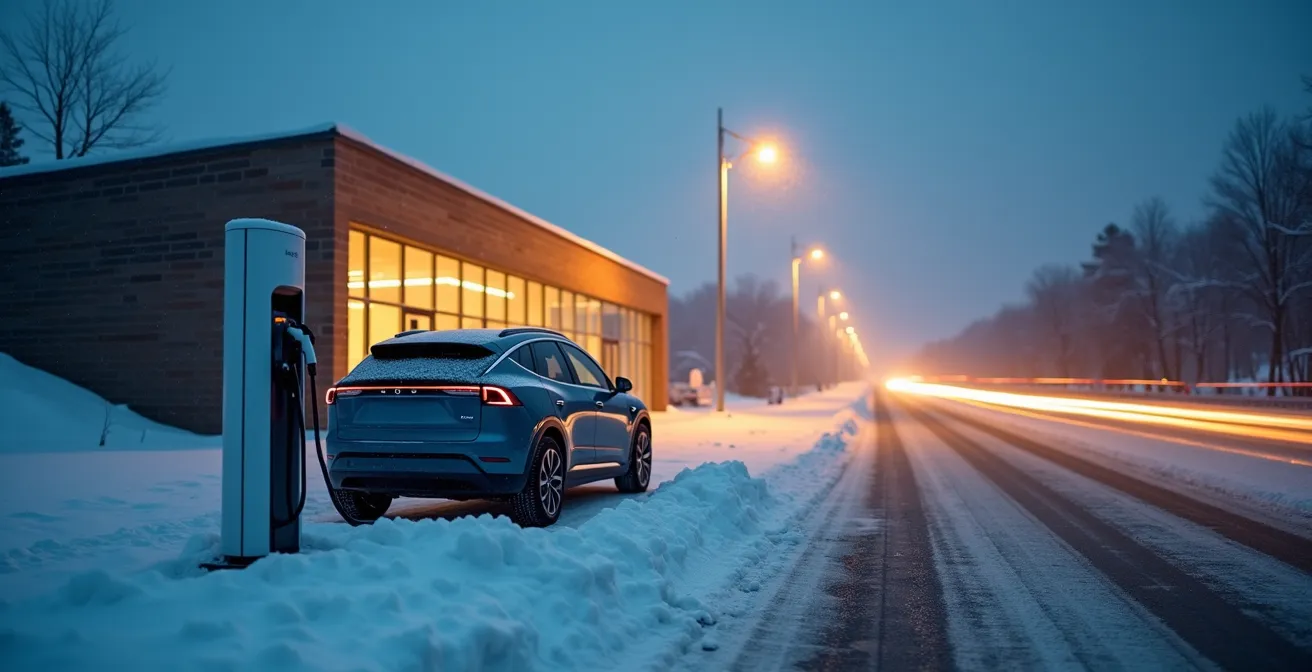
This approach emphasizes efficiency in both driving and personal time. It’s also where prioritizing the right charger becomes critical. As the experts at A Better Route Planner emphasize, speed is everything.
Driving an extra 10 minutes to a 150kW+ charger to save 30 minutes of charging time at a 50kW unit is always the right decision. Your trip time will be shorter and more comfortable.
– A Better Route Planner Team, Winter EV Road Trip Planning Guide 2024
A well-planned trip feels less like a series of stops and more like a seamless flow, where both driver and vehicle are refueled and ready for the next leg of the journey.
The Q4 Mistake: Why Blowing Your Budget in December Is Inefficient for B2B
For any driver who relies on their vehicle professionally, or simply for anyone who values their time and money, the “Q4 Mistake” in the world of EVs is not about financial accounting. It’s about blowing your precious energy budget during the harshest winter months (the “fourth quarter” of the year) by being unprepared. This inefficiency translates directly into lost time, missed appointments, and heightened stress—all of which have a real-world cost.
The principles that apply to a frustrated commuter are magnified exponentially in a commercial or fleet context. An untrained driver facing winter conditions for the first time is a liability. They are more likely to experience severe range anxiety, take inefficient routes, or worse, get stranded. The cost of this unpreparedness goes far beyond the price of electricity.
Fleet Management Lessons from Cold Weather Operations
A deployment of electric delivery vans by Lightning eMotors provided stark data on this issue. They found that untrained drivers operating in January experienced 40% more range anxiety-related incidents and had 25% more missed deliveries compared to drivers who had received a pre-winter training session. As a result, the company now mandates a “Winter Readiness Protocol” for all drivers. This includes education on pre-conditioning, mandatory route planning with a 25% range buffer, and active, real-time battery monitoring through telematics to anticipate problems before they occur.
The financial implications of ignoring these operational details are significant. As a fleet management analysis shows, the downstream cost of failure is enormous: a single missed sales meeting or a failed delivery due to poor range planning can easily cost a business more than a full year’s worth of electricity for that vehicle.
Whether for personal or professional use, treating your EV’s energy budget with the same seriousness as a financial budget is the key to maximizing its value and reliability in winter.
Key takeaways
- Pre-conditioning the battery while plugged in is the single most important action to maximize winter range, as it uses grid power for the initial warm-up.
- For accurate range prediction, trust your vehicle’s real-time efficiency metric (kWh/100km or mi/kWh) after the first 15-20 minutes of driving, not the initial dashboard estimate.
- Implement a “defensive” trip planning strategy by setting a 25-30% winter range buffer and prioritizing high-speed (150kW+) charging stations, even if they require a small detour.
How to Plan Fast-Charging Stops for Trips Over 500km?
Planning a long-distance winter road trip of over 500km (or 300+ miles) requires a shift from optimistic summer planning to a more cautious, “defensive” strategy. The goal is to build in buffers that account for every variable: lower efficiency, potential charger occupancy or failure, and unpredictable weather. This proactive approach is the ultimate tool for eliminating range anxiety and ensuring a smooth journey.
Your primary tool will be a modern EV-specific route planner (like A Better Route Planner, PlugShare, or your vehicle’s built-in system). However, instead of using the default settings, you must adjust them to reflect winter realities. This defensive planning strategy involves several key steps:
- Set Higher Reference Consumption: Manually increase the app’s reference consumption by 25-30% from its default value. This forces the planner to calculate a more realistic, conservative route from the outset.
- Plan for a High Arrival SoC: Configure the planner to ensure you arrive at each charging stop with a minimum of 20% state of charge. This provides a critical buffer if a charger is unexpectedly out of service, allowing you to reach the next one without stress.
- Prioritize High-Speed Chargers: Filter your search for DC fast-chargers rated at 150kW or higher. As discussed, spending less time charging is more valuable than saving a few miles of driving.
- Check Recent User Reviews: Before committing to a stop, check recent reviews on apps like PlugShare. Look for comments from the last 24-48 hours confirming the chargers are operational and delivering their advertised speeds.
- Build in ‘Leapfrog’ Options: Mentally (or in the app) identify a backup charger 30-50 miles beyond your planned stop. Knowing your “Plan B” in advance removes the panic if Plan A fails.
- Align Stops with Breaks: Schedule your longest charging session to coincide with a meal break. This makes a 30-40 minute charge feel like zero time lost.
If this level of planning seems daunting, consider the real-world proof from the world’s most mature EV market. Despite its notoriously harsh winters, EV adoption has soared. For example, data from early 2024 showed that 96% of all new car sales in Norway were EVs. This is definitive proof that with the right infrastructure and driver knowledge, EVs are more than capable of handling severe cold.
By adopting this defensive and informed planning framework, you transform a potentially stressful winter journey into a predictable and comfortable adventure, proving that with the right approach, an EV is a viable year-round vehicle anywhere in the world.