
Contrary to popular belief, the solution to excessive meetings isn’t just to make them shorter; it’s to fix the broken information flow that makes them necessary in the first place.
- Bloated meetings are a symptom of poorly defined artifacts, unclear processes, and inefficient team structures.
- Focusing on artifact-driven work—like a well-groomed backlog and a clear Definition of Done—eliminates the need for lengthy discovery sessions disguised as meetings.
Recommendation: Shift your team’s effort from “optimizing meetings” to optimizing the asynchronous alignment and systemic flow of work that feed into them.
Your calendar is a sea of recurring blocks: Daily Standup, Sprint Planning, Backlog Refinement, Sprint Review, Retrospective. You adopted Scrum to increase speed and flexibility, but it feels like you’ve traded development time for a full-time job in “attending ceremonies.” You’re drowning. The common advice is to “be more disciplined,” “use a timer,” or “have a better agenda.” This is like putting a bandage on a broken leg. It misses the point entirely.
The hard truth is that your meetings are long and painful because they are being used as a crutch for a broken process. They have become expensive, real-time debugging sessions for a lack of clarity, alignment, and preparation. When the Product Backlog is a vague wish list, Sprint Planning becomes a chaotic discovery mission. When the Definition of Done is weak, the Sprint Review turns into a live QA session. These aren’t meeting problems; they are systemic bottlenecks that manifest as meeting problems.
This guide will not give you tips on how to shave two minutes off your standup. Instead, it will provide a pragmatic, anti-bureaucracy roadmap to fix the root causes. We will dismantle the dysfunctions in your artifacts, processes, and team structures that force you into meeting hell. The goal is to make your synchronous time so efficient that it becomes a formality—a quick validation checkpoint in a well-oiled machine, not the engine itself. By focusing on asynchronous alignment and robust artifacts, we will restore agility to your workflow.
For those who prefer a visual format, the following video provides a concise overview of the Scrum framework’s intended structure, which is the foundation we’ll build upon to streamline its execution.
This article is structured to tackle the most common ceremony-related pain points one by one, not by treating the symptoms, but by re-engineering the underlying process. Below is a summary of the key areas we will address to reclaim your team’s valuable time and focus.
Summary: A Practical Guide to Escaping Scrum Meeting Overload
- Why Your Daily Standup Lasts 30 Minutes Instead of 15?
- How to Write a Definition of Done That Prevents QA Bottlenecks?
- Continuous Flow or Sprints: Which Method Fits Maintenance Teams Better?
- The Hybrid Process Mistake That Kills Agility in Large Orgarnizations
- How to Groom Your Backlog to Ensure Sprint Planning Takes Less Than 1 Hour?
- Why Feedback Loops Must Be shorter Than 2 Weeks to Be Effective?
- How to Create Cross-Functional Teams That React to Tech Updates in Days?
- How to Plan Iterative Sprints That Deliver Shippable Value Every Time?
Why Your Daily Standup Lasts 30 Minutes Instead of 15?
If your Daily Standup feels like a “zombie status report” where everyone recounts their previous day in excruciating detail, the problem isn’t the people—it’s the format. The classic “what I did, what I’ll do, what’s in my way” structure invites narrative storytelling instead of collaborative problem-solving. This turns the standup into a reporting session for the Scrum Master or manager, rather than a planning session for the team. The meeting’s focus shifts from the work to the individual, which is the root cause of its bloat.
The solution is to make the work itself the agenda. This is achieved by shifting to a “Walk the Board” format. Instead of going person by person, the team goes column by column on the Sprint Backlog or Kanban board, starting from the right (items closest to “Done”). The only question that matters for each card is: “What do we need to do to move this item one step to the right today?” This immediately re-centers the conversation on flow, dependencies, and swarming to get work finished.
This artifact-driven approach transforms the standup from a status update into a micro-planning session. As one team that successfully cut their standup time found, visualizing the Sprint Backlog on a Kanban board and focusing on moving items was key. They color-coded work linked to the Sprint Goal, making priorities instantly visible. The conversation is no longer about justifying yesterday’s time but about strategizing how to win today. The board becomes the single source of truth and the conductor of the meeting, naturally keeping it concise and fiercely focused on completion.
How to Write a Definition of Done That Prevents QA Bottlenecks?
A recurring theme in painful Sprint Reviews and Retrospectives is the “it’s done, but…” problem. Work is “code complete,” but it’s buggy, not tested on all browsers, or fails under load. This creates a massive QA bottleneck at the end of the sprint, leading to stressful hand-offs and, inevitably, long meetings to triage the fallout. This happens because the team is operating with a weak or singular Definition of Done (DoD). A generic DoD that applies to every user story is simply not robust enough to guarantee quality for complex software.
Preventing this bottleneck requires two things: a robust team structure and a sophisticated DoD. First, a common systemic issue is an imbalanced team; some research shows the optimal team composition requires a 1:3 ratio (one QA to every three engineers) to handle the testing workload effectively. Without this, even the best process will fail. Secondly, you need to evolve from a single checklist to a tiered Definition of Done. This means creating multiple DoDs that build upon each other based on the nature of the work item.
A tiered approach ensures that the right level of quality is applied to the right type of work, preventing both over-engineering on simple tasks and under-testing on critical ones. This artifact-driven quality control moves testing from a “phase” at the end to an integrated part of the development process for every story, effectively dismantling the QA bottleneck before it can form.
This strategy provides a clear, objective measure of completeness, as detailed in the following comparison.
| DoD Level | Applies To | Key Criteria |
|---|---|---|
| Base DoD | All user stories | Code reviewed, unit tests pass, integrated into clean build |
| User-Facing DoD | UI changes | Base + automated UI tests, cross-browser testing, accessibility checks |
| Data-Critical DoD | Database work | Base + automated regression tests pass, performance benchmarks met |
Continuous Flow or Sprints: Which Method Fits Maintenance Teams Better?
Many teams, particularly those in maintenance, operations, or support, struggle with Scrum’s sprint structure. Their work is characterized by a high volume of unpredictable, small-to-medium-sized tasks that don’t fit neatly into a two-week forecast. Forcing them into sprints leads to constant interruptions, failed Sprint Goals, and frustrating planning meetings where they try to predict the unpredictable. This is a classic case of using the wrong tool for the job. For these teams, a continuous flow model is far more effective.
By adopting a Kanban or Scrumban approach, these teams can ditch the overhead of fixed-length sprints. Work is pulled from the backlog as capacity becomes available, focusing the team on one metric above all: Work in Progress (WIP) limits. This prevents the team from being overloaded and forces them to finish work before starting new tasks. This shift alone can be powerful, as various agile approaches can increase team productivity by 25 to 30% when correctly implemented. The focus moves from “did we meet the sprint forecast?” to “how quickly can we get the next important item from ‘To Do’ to ‘Done’?”
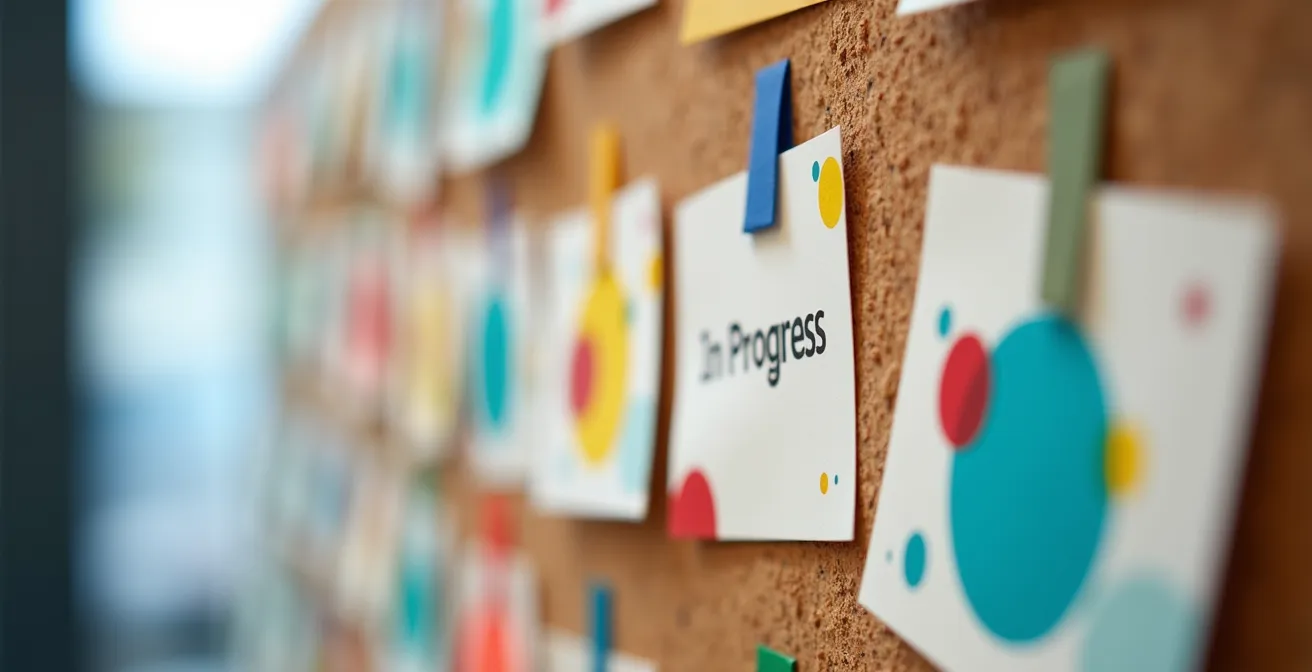
To manage the inevitable “urgent” requests, this model uses “Classes of Service.” This is a method of categorizing work by priority and assigning different policies to each. For example, a critical production bug would go into an “Expedite” swimlane with a near-zero WIP limit and a strict Service Level Agreement (SLA), while regular feature requests follow the standard flow. This provides a structured way to handle emergencies without derailing the entire team’s workflow, bringing order to the chaos of maintenance work.
Your Action Plan: Implementing Classes of Service in Kanban
- Create dedicated swimlanes for ‘Expedite’ (critical bugs with 24-hour SLA)
- Set up ‘Standard’ lane for regular tickets with 5-day cycle time
- Establish ‘Intangible’ lane for technical debt with flexible deadlines
- Define WIP limits for each service class to prevent overload
- Use visual indicators (colors/icons) to distinguish urgency levels at a glance
The Hybrid Process Mistake That Kills Agility in Large Orgarnizations
In large organizations, a common and fatal mistake is attempting to bolt an “agile” process onto a rigid, siloed organizational structure. You might have teams doing two-week sprints, but if the Development team has to hand off work to a separate QA department, which then has to file a ticket with the Operations department for deployment, you are not agile. You are running a mini-waterfall process inside an agile wrapper. This is “cargo cult” agile, and it’s why agility fails to scale.
The hand-offs between these silos create queues, delays, and endless meetings for coordination, status updates, and blame-shifting. As one contributor on a Scrum.org forum succinctly put it:
If you have separate Dev, QA, and Ops departments, your ‘agile’ process will always be a slow, siloed hand-off.
– International Scrum Community, Scrum.org Forum Discussion on QA in Sprint
This problem is a textbook illustration of Conway’s Law, which states that organizations design systems that mirror their own communication structures. To break this cycle, you must change the structure. The solution at scale is to create genuine cross-functional teams and coordinate them effectively. A proven pattern for this is the “Scrum of Scrums” (SoS). An SoS is a virtual team composed of representatives from various delivery teams. Its purpose is not to manage, but to coordinate and remove inter-team impediments.
Case Study: Coordinating at Scale with Scrum of Scrums
The aim of a Scrum of Scrums is to coordinate smaller, independent teams to deliver a fully integrated product. By embedding links between delivery teams, this structure reduces the long communication paths typical in hierarchical organizations. Instead of siloed hand-offs, the focus shifts to ensuring that a fully integrated, shippable product is ready at the end of every sprint, with teams collaborating to resolve dependencies in real-time rather than waiting in queues.
How to Groom Your Backlog to Ensure Sprint Planning Takes Less Than 1 Hour?
Sprint Planning is the ceremony most likely to spiral out of control. If your team walks into planning to see a list of user stories for the first time, you’re not planning; you’re performing emergency analysis. This forces the entire team to spend hours debating scope, questioning requirements, and estimating on the fly. The official Scrum Guide suggests that the recommended sprint planning duration is 2 hours per week of sprint length (e.g., 4 hours for a 2-week sprint). But a mature, efficient team can do it in under an hour.
The secret is to treat backlog refinement (or “grooming”) not as a single, painful, multi-hour meeting, but as a continuous, lightweight activity. This is the essence of continuous refinement. Instead of one large meeting with the whole team, you implement a “3 Amigos” model. This involves short, daily or every-other-day sessions with a trio of perspectives: a Product Owner (representing the “what”), a developer (the “how”), and a QA analyst (the “what if”).

These 15-20 minute sessions focus on refining just one or two upcoming stories at a time. By the time Sprint Planning arrives, the top of the backlog consists of stories that are clear, small, and ready to be pulled into the sprint. The planning meeting transforms from a stressful negotiation into a simple confirmation exercise. The team is no longer “seeing” the work; they are simply validating the forecast and finalizing the Sprint Backlog. This asynchronous preparation is the single most effective way to guarantee a fast, productive Sprint Planning event.
Why Feedback Loops Must Be shorter Than 2 Weeks to Be Effective?
Long feedback loops are the silent killer of agility. A two-week sprint is often misinterpreted as the minimum frequency for feedback, when it should be considered the absolute maximum. Waiting until the Sprint Review to get feedback on work completed in week one is incredibly inefficient. The developer has lost the context of that work, making any required fixes significantly more expensive and time-consuming. The cost of a bug isn’t linear; it’s exponential over time.
The core principle is that the longer it takes to find a problem, the more effort it takes to fix it. When a developer gets feedback minutes after writing code (e.g., from a paired programmer or an automated test), the fix takes seconds. The mental model is still fresh. A day later, it might take 15-30 minutes to re-establish context. But two weeks later? The developer has to completely reload the problem space, review old code, and navigate a codebase that has since evolved. A simple bug fix can balloon into a multi-day effort.
This is why high-performing teams are obsessed with shortening feedback loops within the sprint. They achieve this through practices like:
- Pair Programming: The tightest possible feedback loop, measured in seconds.
- Test-Driven Development (TDD): Automated feedback from unit tests before code is even “finished.”
- Continuous Integration (CI): Automated builds and tests that provide feedback within minutes of a code commit.
- In-sprint QA: Developers and QAs working on the same story simultaneously, not in sequence.
The data clearly shows that delaying feedback is a direct cause of wasted effort, as this analysis of the cost of delay demonstrates.
| Detection Time | Fix Duration | Context Switch Cost |
|---|---|---|
| 5 minutes after writing | Seconds to minutes | Zero – still in context |
| 1 day later | 15-30 minutes | Minor – recent memory |
| 1 week later | 2-4 hours | Moderate – need to review code |
| 2 weeks later (Sprint Review) | 1-2 days | High – full re-contextualization needed |
How to Create Cross-Functional Teams That React to Tech Updates in Days?
In today’s fast-moving technology landscape, waiting for a centralized architecture committee or a single “expert” to approve a technical decision is a death sentence for agility. The ability to react to a new library, a security patch, or an API update in days—not weeks or months—is what separates high-performing teams from the rest. This speed is only possible when you have genuine cross-functional teams empowered to make their own technical decisions.
A cross-functional team isn’t just a group of specialists sitting together; it’s a team where skills are shared and distributed. The goal is to cultivate “T-shaped” professionals—people with deep expertise in one area (the vertical bar of the T) and a broad-enough understanding of other areas to collaborate effectively (the horizontal bar). This prevents bottlenecks where only one person can work on the database or the front-end. Practices like pair programming, internal skill-sharing sessions, and rotating roles are essential for building this collective capability.
Case Study: Decentralizing Decisions with Architecture Decision Records (ADRs)
To empower these teams without creating architectural chaos, a lightweight governance model is needed. One highly effective tool is the Architecture Decision Record (ADR). An ADR is a simple markdown file that documents a significant technical decision, its context, and its consequences. Teams that implemented ADRs were able to make localized technical decisions within 24-48 hours instead of waiting weeks for review board approvals. This approach allows for rapid, decentralized decision-making while maintaining a coherent and well-documented architectural vision across the organization.
By combining T-shaped skills with a decentralized decision-making framework like ADRs, you create resilient teams that can absorb and react to technical change with speed and confidence. They don’t need a meeting with an external board to decide on a library upgrade; they have the context and authority to make the decision, document it, and move on.
Key Takeaways
- Stop trying to optimize meetings and start optimizing the artifacts and processes that make them necessary.
- Treat backlog refinement as a continuous, daily habit, not a single, painful meeting.
- Your Definition of Done must be tiered and robust enough to prevent end-of-sprint quality bottlenecks.
- Empower cross-functional teams with the skills and autonomy to make decisions without needing a meeting.
How to Plan Iterative Sprints That Deliver Shippable Value Every Time?
The ultimate goal of every sprint is not to complete a list of tasks, but to deliver a valuable, shippable increment of the product. Yet, many teams fall into the trap of building “horizontal slices”—completing all the backend work for three features in one sprint, and all the frontend work in the next. This delivers zero value to the end-user until everything is finally integrated. This approach delays feedback, increases risk, and makes a mockery of the term “shippable increment.”
To deliver true value iteratively, you must build “vertical slices.” This means that for a single feature, you build a thin slice through the entire tech stack: from the UI, through the API and business logic, down to the database, and back up again. The first, most crucial vertical slice is the “Walking Skeleton.” This is the bare-bones, end-to-end implementation of the simplest possible feature. It might not be pretty, but it proves that the entire technology stack is wired together and deployable.
From Sprint 1, this skeleton should be deployed to a production-like environment. This forces the team to solve deployment and infrastructure challenges early, de-risking the entire project. Each subsequent sprint then adds more “flesh” to the skeleton, either by enriching the first feature or by adding a new, thin vertical slice for another feature. The key is that at the end of every single sprint, the product is in a working, shippable state. This makes the Sprint Review a powerful demonstration of real, working software, not a PowerPoint presentation of what’s “almost done.”
Ultimately, transforming your workflow from a series of painful meetings into a smooth, value-driven process requires a fundamental shift in mindset. Stop treating ceremonies as the work, and start seeing them as brief checkpoints in a system designed for continuous flow and asynchronous collaboration. By investing in the health of your artifacts and the autonomy of your team, you will find that your meeting problems solve themselves.