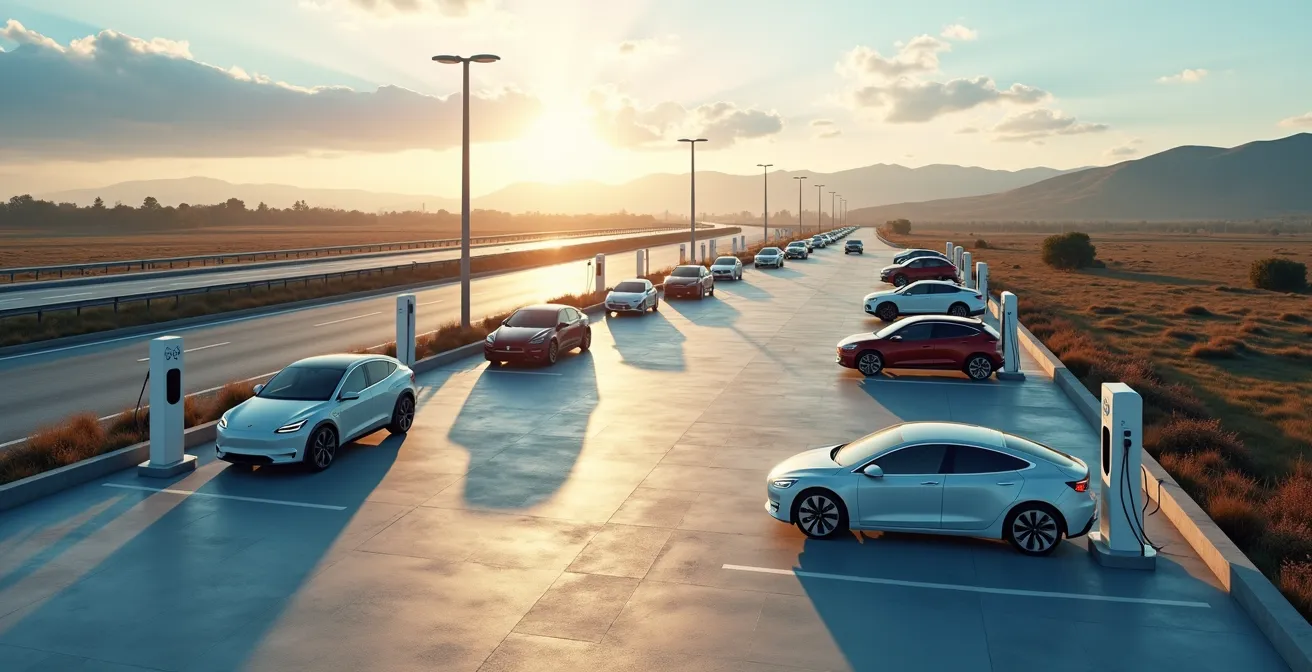
The key to a stress-free long EV trip isn’t a single app, but a resilient strategy that anticipates the charging network’s inherent flaws.
- Master the 80% charging rule to save time and preserve your battery’s long-term health.
- Build a “digital go-bag” with multiple network accounts to overcome ecosystem fragmentation.
- Use crowd-sourced apps to verify charger status in real-time, avoiding broken or occupied stations.
Recommendation: Before any long trip, audit your charging preparedness by identifying all networks on your route and pre-verifying payment methods in each corresponding app.
The promise of the open road in an electric vehicle is exhilarating—silent, smooth, and sustainable. But for any trip stretching beyond 500km, a quiet hum of anxiety can creep in. This isn’t just about range; it’s about the unknowns. What if the next charger is broken? What if I need three different apps and a weak signal foils my plans? This is “Range Anxiety,” and it’s a logistical challenge more than a technological one.
Many guides will tell you to simply use a route planner and map your stops. While that’s a start, it’s a fragile strategy that assumes a perfect world. The reality of today’s charging infrastructure is one of fragmentation, variable reliability, and physical constraints. A successful long-distance EV driver doesn’t just plan a route; they become a savvy logistician, armed with a multi-layered system that anticipates and neutralizes these points of failure.
But what if the real secret isn’t just better planning, but building a more resilient logistical mindset? This guide moves beyond simple A-to-B routing. We’ll deconstruct the core challenges of a long-distance EV trip and give you the strategic framework to conquer them. We’ll explore the physics of fast charging, the reality of network reliability, the necessity of a “digital go-bag,” and the tactics to make charging stops feel like a strategic advantage, not a time-wasting chore.
This article provides a complete logistical framework for planning your next long-distance EV journey. Each section tackles a critical point of failure, providing you with the knowledge and tools to build a truly resilient travel plan.
Summary: Flawlessly Plan Fast-Charging Stops for EV Trips Over 500km
- Why Charging Speed Drops Drastically After 80% Capacity?
- How to Use Crowd-Sourced Apps to Avoid Broken Chargers?
- CCS or Tesla Supercharger: Which Network Is More Reliable for Non-Teslas?
- The App Mistake: Why You Need 5 Accounts to Cross the Country?
- How to Combine Charging With Bio-Breaks to Lose Zero Travel Time?
- Why Generative Models Predict Demand Better Than Traditional Statistics?
- The Form Field Mistake That Kills 50% of Mobile Conversions
- How to Maximize Battery Autonomy in Cold Weather Conditions?
Why Charging Speed Drops Drastically After 80% Capacity?
One of the first lessons for any EV road-tripper is a counter-intuitive one: a full battery is an inefficient goal. At a DC fast-charging station, your vehicle’s battery charges at its maximum speed only within a specific window, typically between 20% and 80%. Once you pass the 80% capacity mark, the charging speed slows to a crawl. This phenomenon, known as the charging taper, is a safety feature managed by the Battery Management System (BMS) to prevent overheating and cell degradation.
Think of it like filling a glass of water. You can pour quickly at the beginning, but as you approach the brim, you slow down to a trickle to avoid spilling. The BMS does the same, carefully managing the voltage and current to safely top off the final 20%. Forcing a charge to 100% at a fast-charger not only wastes significant time (the last 20% can take as long as the first 60%) but also puts unnecessary stress on the battery.
Adhering to the 20-80% rule during road trips is a cornerstone of efficient travel and long-term battery health. This strategy minimizes your time at the charger and preserves your battery’s longevity. Real-world data confirms this; a long-term study on Tesla vehicles showed that after 200,000 miles, batteries managed with smart charging strategies had lost just 15% of their capacity on average, demonstrating the tangible benefits of avoiding consistent charges to 100%.
How to Use Crowd-Sourced Apps to Avoid Broken Chargers?
Pulling up to a charging station only to find it out of order is a top source of range anxiety. Unfortunately, the official apps from charging networks don’t always provide real-time, accurate data on a station’s operational status. A charger might be listed as “available” when in reality it’s broken, blocked by a non-charging vehicle, or operating at a reduced speed. This is where the power of the community becomes your most reliable tool.
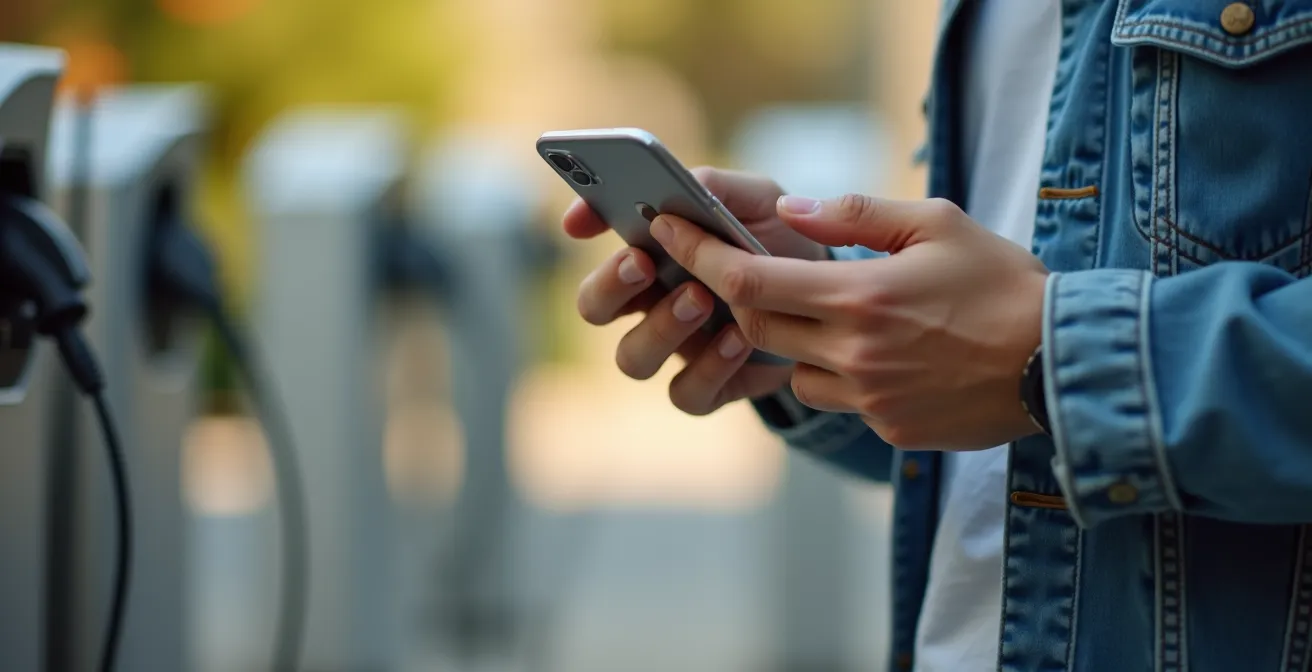
Apps like PlugShare operate on a foundation of crowd-sourced data. Instead of relying solely on network-provided information, these platforms allow drivers to “check in” and leave real-time feedback on their charging experience. Drivers can report if a station is working, broken, or if there’s a long wait. This collective intelligence provides a much more accurate, on-the-ground picture of the network’s health.
Before heading to a charging stop, it’s crucial to check its recent history on a crowd-sourced app. Look for recent, positive check-ins. A key feature to look for is a reliability rating system, such as PlugShare’s PlugScore. This score, which rates stations from 1 (avoid) to 10 (excellent), is aggregated from recent user check-ins. A high score from multiple users in the last 24 hours is the strongest signal you can get that your charging stop will be successful.
This simple act of verifying a station’s status through the eyes of fellow drivers transforms your plan from a hopeful guess into a confirmed logistical step. It also creates a positive feedback loop, pressuring network providers to maintain their equipment to keep their public-facing scores high. Relying on the community is a fundamental shift from passive planning to active, resilient strategizing.
CCS or Tesla Supercharger: Which Network Is More Reliable for Non-Teslas?
For years, the EV charging world was divided. Tesla had its proprietary network, and almost every other automaker used the Combined Charging System (CCS). Today, with Tesla opening up its Supercharger network to other brands, non-Tesla drivers face a new logistical choice. Deciding which network to prioritize on a long trip depends on a trade-off between compatibility, convenience, and network density.
While most non-Tesla EVs are natively equipped for CCS chargers, accessing the Supercharger network requires an NACS adapter. These adapters, now available from most major manufacturers, physically connect the Tesla plug to your vehicle’s CCS port. However, access is still limited to specific V3 and V4 Superchargers and requires your vehicle’s software to be compatible. Another practical issue is the notoriously short cable length at Supercharger stalls, which can require awkward parking maneuvers depending on your vehicle’s charge port location.
On the other hand, the Tesla Supercharger network is widely regarded as the most reliable and expansive in North America. Real-world testing has confirmed the viability of using this network for other brands; a recent analysis showed that with the right equipment, the third-party adapters work, and quickly at V3 Superchargers. The decision often comes down to your specific route and risk tolerance. The table below breaks down the key differences to help you strategize.
| Factor | Tesla Supercharger | CCS Networks |
|---|---|---|
| Network Size | 50,000+ chargers in North America | Combined networks smaller but growing |
| Compatibility | Only V3 and V4 chargers with adapter | Native compatibility for most non-Teslas |
| Adapter Required | Yes ($185-$225 from manufacturers) | No adapter needed |
| Availability | Limited to approved vehicles with software updates | Universal for CCS-equipped EVs |
| Cable Length | Shorter cables may require specific parking | Typically longer, more flexible positioning |
The App Mistake: Why You Need 5 Accounts to Cross the Country?
The single biggest logistical mistake a new EV driver can make is assuming one app is enough. Unlike the gas station model, where a single credit card works everywhere, the EV charging world suffers from severe ecosystem fragmentation. Major charging providers like Electrify America, EVgo, and ChargePoint all operate their own networks, each requiring its own app, account, and payment method.
Relying on a single network is a recipe for disaster. You might plan a stop at an Electrify America station, only to find it full or broken. If the only other nearby station belongs to EVgo and you don’t have an account, you’ll be stuck fumbling with app downloads and credit card entries in a location with potentially poor cell service. The solution is to prepare a digital go-bag before your trip even begins.
This involves downloading the apps for all major networks along your route, creating accounts for each, and pre-loading your payment information. This simple preparation, done from the comfort of your home, can save you immense frustration on the road. Some networks also offer RFID cards that allow you to initiate a charge by simply tapping the card, bypassing the app entirely—a great backup if your phone battery is low or your connection is weak. This redundancy is the core of a resilient charging strategy.
Action Plan: Auditing Your Charging Preparedness
- Points of contact: List all charging networks along your 500km+ route (e.g., Electrify America, EVgo, ChargePoint, Tesla).
- Collecte: Inventory the apps and RFID cards you already have. Do you have accounts for all networks identified?
- Cohérence: Confront your setup with your trip’s reality. Are payment methods verified and up-to-date in each app?
- Mémorabilité/émotion: Check user reviews on an app like PlugShare for your planned stops. Are they rated 8+ (reliable) or below 5 (risky)?
- Plan d’intégration: Download missing apps, complete sign-ups, and order necessary RFID cards at least one week before your trip.
How to Combine Charging With Bio-Breaks to Lose Zero Travel Time?
One of the most significant mental shifts for a long-distance EV driver is to stop viewing charging as “lost time.” Instead, a savvy planner sees it as repurposed time. The goal is time-neutral charging, where the time spent replenishing your car’s battery is perfectly aligned with the time you and your passengers need to replenish your own energy. This approach transforms a logistical necessity into a welcome break that enhances the journey.
The key is to align the duration of the charge with the duration of the activity. As we’ve learned, a fast charge from 20% to 80% is the sweet spot for efficiency. For most modern EVs, this process takes between 20 and 40 minutes at a DC fast charger. This window is ideal for a quick meal, a proper restroom break, or stretching your legs. Planning your stops at locations that offer these amenities is fundamental. Many charging stations are now strategically located in shopping centers or near restaurants.
For longer breaks, you can get creative. Some drivers pack a frisbee or a ball to play with kids while the car charges. With more roadside attractions, museums, and even movie theaters adding EV chargers, you can integrate a small activity into your itinerary. The data supports this strategy perfectly, with studies showing a typical fast charge to 80% takes 20-40 minutes at fast chargers, perfectly aligning with the duration of a standard meal or rest break. This strategic overlap means you lose virtually zero travel time.
Why Generative Models Predict Demand Better Than Traditional Statistics?
The first generation of route planners simply showed you where chargers were. The modern tools, however, do much more than that—they predict the entire journey. This is thanks to the power of generative models, a form of AI that creates a dynamic travel plan based on a multitude of variables, far surpassing what traditional statistical analysis could ever achieve.
A traditional planner might tell you the distance to the next charger. A tool like A Better Routeplanner (ABRP) will tell you the exact state of charge you’ll have when you arrive. It does this by creating a complex model of your trip that considers not just your car’s make and model, but also external factors like elevation changes, ambient temperature, estimated crosswinds, and even the extra weight from passengers and luggage. It simulates the entire drive minute by minute.
This predictive power is a game-changer for eliminating range anxiety. The model can tell you, “You will arrive with 15% battery,” a far more reassuring statement than just knowing a charger is 200km away. As a robust tool every EV driver should have, ABRP lays out charging stops down to the minute and vehicle battery percentage based on user inputs. By leveraging these AI-powered tools, you’re not just finding chargers; you’re running a sophisticated simulation of your trip before you even leave, allowing you to identify potential issues and adjust your plan with a high degree of confidence.
The Form Field Mistake That Kills 50% of Mobile Conversions
In the world of e-commerce, a “form field mistake” refers to a poorly designed digital form that causes users to abandon a purchase. In the context of an EV road trip, the most critical “form field mistake” is entirely analog: it’s focusing so much on digital preparation that you forget the essential physical gear. A flawless digital plan can be instantly derailed by a missing piece of hardware.
The most crucial piece of physical equipment in your arsenal, after any necessary charging adapters, is a Level 2 charging cable. While DC fast chargers are your primary tool on the highway, they aren’t always available at your destination or overnight stops. Hotels, friends’ houses, or even public parking garages often provide Level 2 AC outlets (similar to a 240V household dryer outlet). Having your own cable allows you to take advantage of this “opportunity charging,” ensuring you wake up with a full battery without having to find a commercial station.
This physical preparedness is the final layer of your resilient logistics strategy. It’s the backup to your backup. Your digital go-bag of apps and accounts gets you from A to B, but your physical go-bag, including the essential Level 2 cable, provides crucial flexibility and peace of mind once you’ve arrived. Neglecting this physical “form field” is a common oversight that can add significant stress and inconvenience to your trip.
Key takeaways
- The 80% Rule: Save time and protect your battery by planning charges from ~20% to 80% at DC fast chargers.
- The Digital Go-Bag: Overcome network fragmentation by creating accounts with multiple charging providers before your trip.
- Crowd-Sourced Validation: Use apps like PlugShare to check real-time user reports and avoid broken or occupied chargers.
How to Maximize Battery Autonomy in Cold Weather Conditions?
Your EV’s battery is a chemical powerhouse, and its performance is highly sensitive to temperature. While extreme heat can accelerate long-term degradation, it’s cold weather that has the most immediate and dramatic impact on your driving range. Ignoring the effects of cold is one of the quickest ways to find yourself with far less range than your car’s display initially promised.
The reason for this is twofold. First, the electrochemical reactions inside the battery slow down in the cold, reducing its efficiency. Second, and more significantly, your car must expend a large amount of energy to heat the cabin for you and to keep the battery itself at an optimal operating temperature. This energy drain comes directly from the same battery that powers the wheels, leading to a significant range penalty. In fact, real-world data shows that cold weather can reduce range by 25-30%.
To counteract this, a few logistical adjustments are crucial. The most effective strategy is preconditioning. By heating the battery and cabin while the car is still plugged in at home or at a charger, you use energy from the grid, not your battery. During the drive, rely on heated seats and a heated steering wheel, which consume far less energy than the main cabin heater. Finally, be more conservative in your winter travel planning: assume shorter legs between charging stops and build in a larger buffer to account for the unavoidable 25-30% range reduction.
With these logistical strategies in your toolkit, you can transform range anxiety into range confidence. The next step is to put this knowledge into practice by building your own resilient plan for your next great adventure.