
The key to professional relevance is not consuming more information, but architecting a personal knowledge system that filters signal, maximizes retention, and compounds over time.
- Your professional skills have a five-year half-life, demanding constant renewal, not just occasional updates.
- Success depends on a ruthless information diet that prioritizes high-signal, first-principle sources over high-noise, surface-level content.
Recommendation: Shift from a passive “learning” mindset to an active “knowledge architecture” strategy. Start by building a system to filter, consume, and retain one key concept daily.
As an executive, you operate in a state of perpetual motion. Yet, despite the constant activity, a nagging feeling persists: you’re falling behind. You see new trends, new technologies, and new terminologies emerging at a pace that feels impossible to match. The conventional advice you receive is well-meaning but ultimately ineffective. You’re told to “read more books,” “take online courses,” or “listen to podcasts.” This approach treats learning as another task to be squeezed into an already overflowing schedule. It leads to fragmented knowledge, minimal retention, and ultimately, burnout.
This endless cycle of content consumption is a losing battle. The sheer volume of information available ensures that you will always be behind. But what if the goal isn’t to consume everything? What if the key to maintaining your edge lies not in the quantity of information you absorb, but in the quality of the system you build to process it? The fundamental error is treating learning as a passive act of consumption rather than an active process of construction. It’s time to stop being a mere consumer of information and become an architect of your own intelligence.
This guide presents a different paradigm. It’s a system designed for high-performance individuals who measure success in outcomes, not hours logged. We will deconstruct the process of building a sustainable, high-ROI learning habit that requires no more than 15 minutes a day. We’ll move from understanding the urgency of skill renewal to designing a system that filters noise, optimizes consumption, and hardwires knowledge for long-term recall. This is not about learning more; it’s about learning smarter, with a structure that turns fleeting information into a permanent cognitive asset.
This article provides a structured approach to building that system. Below, you will find a complete roadmap, from identifying the problem to implementing the daily practices that ensure your professional relevance for years to come.
Summary: A System for Lifelong Professional Relevance
- Why Your Current Skills Will Be Worth Half as Much in 5 Years?
- How to Filter Your Information Diet to Avoid Noise?
- Audio or Text: Which Medium Retains Information Better During Commutes?
- The Over-Optimization Mistake: Trying to Learn While Resting
- How to Use Anki or Flashcards to Remember Key Concepts Forever?
- How to Reclaim 4 Hours of Focus Daily by Blocking Digital Noise?
- How to Design a Morning Routine Without Screens for Better Mental Clarity?
- How Hyper-Connectivity Rewires the Brain’s Ability to Focus Deeply?
Why Your Current Skills Will Be Worth Half as Much in 5 Years?
The sense of urgency you feel is not an illusion; it’s a market reality. Your current expertise, the very foundation of your career, is a depreciating asset. The half-life of professional skills has plummeted. Recent research suggests that the half-life of professional skills has dropped from a comfortable 10-15 years to just five years. For technical skills, the decay is even more rapid, with a half-life now under two and a half years. This means that in five years, half of what you know and do today to be effective will be irrelevant.
This isn’t a distant, abstract threat. It’s an active process of displacement driven by technological acceleration, particularly in fields like artificial intelligence. The value of your current skill set is being eroded not by incompetence, but by obsolescence. Relying on your existing knowledge is like trying to navigate a new city with an old map. To stay relevant, you must shift from a mindset of “having skills” to one of “perpetual skill renewal.” This requires a systematic, non-negotiable approach to learning, integrated into your daily operations.
Case Study: The AI Skills Demand Explosion
The speed of this shift is unprecedented. A recent analysis of technology skills found that AI went from being the sixth most scarce technology skill to the number one most in-demand skill in just 16 months. This was the fastest and most dramatic increase in skills demand observed in over 15 years, demonstrating how quickly a niche expertise can become a core requirement.
Your first action is to diagnose your own vulnerability. You cannot manage what you do not measure. An audit of your personal skill portfolio is not an academic exercise; it’s a strategic necessity to build your knowledge architecture.
Your Personal Skills Half-Life Audit
- Identify Contact Points: List the top 10 professional skills you use daily. These are the “points of contact” where your value is delivered.
- Collect and Inventory: For each skill, inventory its current market relevance. Is it a core requirement in recent high-level job postings in your industry?
- Assess for Coherence: Confront each skill with future trends. Categorize them as ‘Stable’ (slowly evolving), ‘Decaying’ (at risk of automation), or ‘Emerging’ (growing in demand).
- Evaluate Mémorability & Impact: Identify your unique “signature” skills. Which ones differentiate you from your peers versus those that are generic and easily replaceable?
- Create an Integration Plan: Design a learning roadmap. Prioritize acquiring 1-2 emerging skills while strategically updating your most critical stable skills. This is the first blueprint for your learning habit.
How to Filter Your Information Diet to Avoid Noise?
Now that the urgency is established, the immediate challenge is not finding information, but deflecting it. You are inundated with noise: trending articles, shallow social media debates, and endless newsletters. An effective learning system is not built on consumption, but on ruthless filtration. Your goal is to drastically improve your information’s signal-to-noise ratio (SNR). High-signal information is rooted in first principles, evidence, and intellectual honesty. High-noise content is driven by opinion, engagement metrics, and shallow trends.
Treat your information intake like a diet. Most executives are on a junk food diet of low-quality, high-volume information that provides a temporary sugar rush of feeling “informed” but lacks any real nutritional value for long-term growth. You must become a discerning gatekeeper. This means unsubscribing aggressively from newsletters that don’t provide deep insights, unfollowing “thought leaders” who only echo popular sentiment, and replacing broad, shallow news sources with deep, domain-specific publications or primary research.
A powerful tool for this is the “Signal vs. Noise” framework. Before consuming any piece of content, evaluate it against a set of objective criteria. This deliberate, upfront filtering saves you hours of wasted cognitive energy on information that doesn’t contribute to your cognitive assets.
| Criteria | High Signal Sources | High Noise Sources |
|---|---|---|
| First-Principle Thinking | Explains the ‘why’ behind concepts | Only provides surface-level ‘what’ |
| Data-Driven Evidence | Backed by research and citations | Opinion-based without sources |
| Intellectual Honesty | Admits limitations and unknowns | Claims absolute certainty |
| Update Frequency | Regular but thoughtful updates | Daily content for engagement |
| Depth vs Breadth | Deep expertise in specific domain | Shallow coverage of trending topics |
Audio or Text: Which Medium Retains Information Better During Commutes?
Your commute is not dead time; it’s a strategic learning opportunity. However, choosing the right medium is critical for retention. The decision between audio and text is not a matter of preference, but of cognitive load. Your brain’s capacity for intake is finite, and the effectiveness of a medium is directly tied to the demands of your primary activity. The goal is to match the learning format to the context of your commute to maximize what we can call retention velocity.
This image below conceptualizes the two primary modes of information intake during transit. On one side, the fluid, wave-like patterns represent audio learning—ideal for situations where your visual and motor functions are occupied, like driving. On the other, the sharp, geometric forms symbolize text—a format that demands focused visual attention, suitable for passive travel like a train or bus ride.

As the visual suggests, there is no single “best” medium. Audio is superior for low-load activities. It allows for broad exposure to new ideas and narratives when your hands and eyes are busy. Think of it as reconnaissance; you’re scanning the landscape for interesting targets. Text, however, is for deep engagement. It excels when you can be stationary and visually focused, allowing you to highlight, re-read, and process complex data or structured arguments. Trying to consume detailed text while navigating traffic overloads your cognitive channels, leading to near-zero retention. Conversely, only using audio may prevent you from ever diving deep into the specifics. A hybrid approach is the most effective strategy for your knowledge architecture.
The Over-Optimization Mistake: Trying to Learn While Resting
In the executive culture of hyper-productivity, rest is often seen as a bug, not a feature. The temptation is to fill every spare moment—even downtime—with “productive” learning. You might listen to a business podcast while on a walk meant for relaxation or read industry reports right before bed. This is a critical mistake. It’s the equivalent of trying to build muscle by never leaving the gym. Growth, in both muscles and minds, happens during recovery.
Your brain is not a computer that is either “on” or “off.” It has different modes of operation. When you are not focused on a specific task, your brain activates a network known as the Default Mode Network (DMN). This isn’t an idle state. In fact, neuroscience research demonstrates that the DMN is crucial for processes like memory consolidation, creative problem-solving, and integrating new information with existing knowledge. When you are truly resting, your brain is silently working to connect the dots, synthesize the information you’ve learned, and generate novel insights.
By constantly bombarding your brain with new input, you prevent the DMN from activating. You are feeding it new data without giving it the time to process and store what it has already received. This leads to a feeling of being constantly “on” but never truly retaining anything. The solution is to be as disciplined about your rest as you are about your work. Protect your downtime ruthlessly. When you rest, truly rest. Go for a walk without headphones. Sit in silence for five minutes. Let your mind wander. This is not laziness; it is a strategic component of an effective knowledge architecture, allowing for the consolidation that makes learning permanent.
How to Use Anki or Flashcards to Remember Key Concepts Forever?
You have now filtered your information sources and consumed a key insight in your 15-minute block. The next and most critical step is to ensure it isn’t lost to the natural process of forgetting. Information that is not actively recalled will decay. The solution is a system that automates recall, forcing your brain to strengthen the neural pathways associated with that new knowledge. This is the domain of spaced repetition systems (SRS), with tools like Anki being the gold standard for executives.
Spaced repetition works by presenting you with a piece of information (a flashcard) at increasing intervals. Just as you are about to forget it, the system prompts you to recall it. This process of active recall interrupts the forgetting curve and signals to your brain that this information is important and must be stored for the long term. It transforms passive knowledge into an active, readily available cognitive asset.
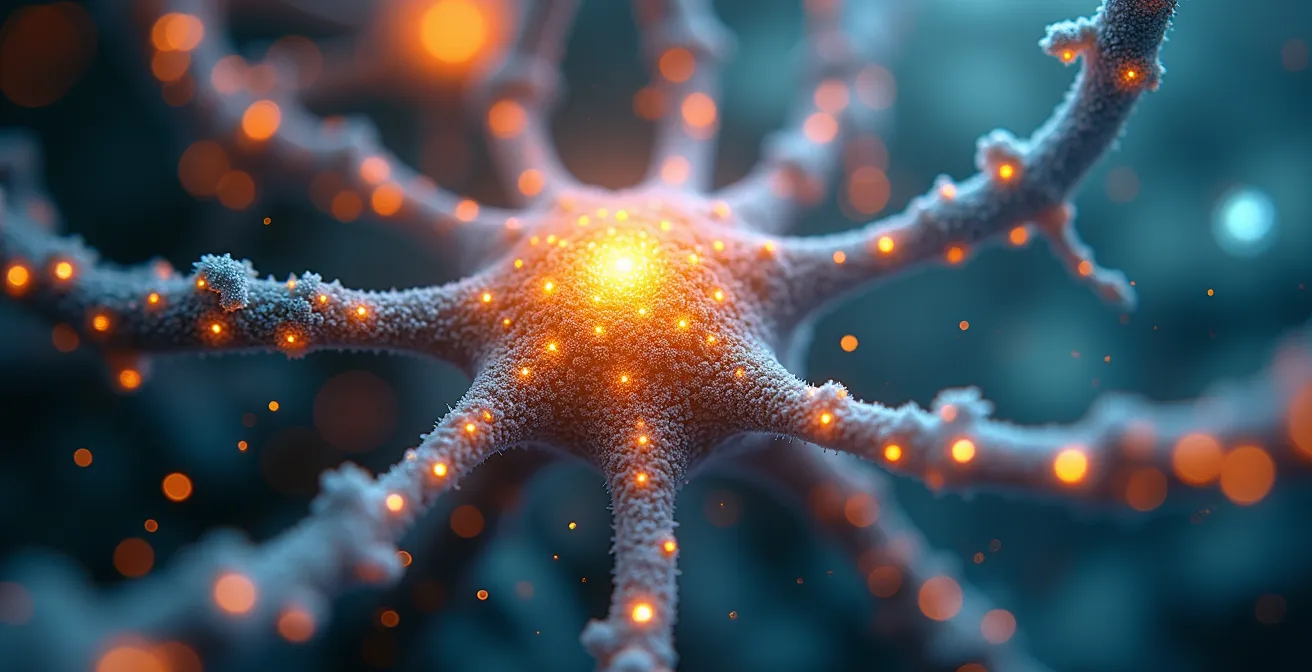
The abstract visualization below represents this process. Each time you successfully recall an item, the memory pathway becomes stronger, more defined, and more integrated into your existing knowledge network, like neural pathways becoming more robust over time.
The key to effective use of SRS is not the volume of cards you create, but the quality of the “knowledge distillation” process. You must break down complex ideas into their smallest, most essential, testable units—atomic concepts. A good flashcard asks for a single, precise piece of information. For example, instead of a card that says “Explain the Default Mode Network,” a better set of cards would be: “What is the primary function of the Default Mode Network? (Answer: Memory consolidation and creative insight)” and “When does the Default Mode Network typically activate? (Answer: During periods of wakeful rest).” This atomization is what makes recall fast and efficient, fitting perfectly into your 15-minute daily habit.
How to Reclaim 4 Hours of Focus Daily by Blocking Digital Noise?
Your 15-minute learning habit cannot exist in a vacuum. Its success depends on your ability to achieve a state of deep focus, not just during that learning block, but throughout your day. The primary obstacle is the constant barrage of “digital noise”—notifications, emails, and alerts from a sprawling ecosystem of software. The irony is that the tools designed to increase productivity are often the biggest destroyers of it. In fact, research reveals that 73% of employees don’t use their assigned software licenses, despite companies using an average of 112 SaaS apps. This is a massive source of cognitive and financial waste.
Reclaiming focus requires creating “environmental friction.” You must make it harder to get distracted than to stay focused. This involves a radical audit of your digital environment. Turn off all non-essential notifications on your phone and desktop. Delete apps you don’t use. Move communication and social media apps off your home screen into a folder that requires multiple taps to access. The goal is to create a deliberate, high-friction path to distraction. When checking Slack requires unlocking your phone, swiping, tapping a folder, and then opening the app, the impulse to “just check” is often extinguished before it’s completed.
The most powerful tool for an executive is to establish a “Communication Pact” with your team. This is a clear, written protocol that defines communication channels, expected response times, and availability windows. It eliminates the anxiety of needing to be “always on” and empowers you to batch-process communications, freeing up large, contiguous blocks of time for deep work and focused learning. A pact replaces chaotic, reactive communication with a structured, predictable system.
| Communication Type | Response Time | Availability Window |
|---|---|---|
| Urgent (Phone/Direct Message) | Within 15 minutes | 9 AM – 5 PM only |
| Important (Email) | Within 4 hours | Check 3x daily: 9 AM, 1 PM, 4 PM |
| Non-urgent (Slack/Teams) | Within 24 hours | Check once at end of workday |
| FYI/Updates | Within 48 hours | Review during weekly planning |
How to Design a Morning Routine Without Screens for Better Mental Clarity?
The battle for focus is won or lost in the first 20 minutes of your day. If you begin your day by reaching for your phone, you are starting in a state of reaction. You are immediately flooded with other people’s priorities, anxieties, and demands delivered through emails and news alerts. This primes your brain for distraction and makes achieving deep focus later in the day exponentially harder. A screen-free morning routine is not a luxury; it is a strategic imperative for any executive serious about controlling their attention.
The objective is to start the day proactively, not reactively. This means deliberately creating a 15-minute analog buffer between waking up and engaging with the digital world. This short period allows you to center your thoughts, activate your body, and set your intentions before the external world can impose its own. It establishes a foundation of mental clarity and control that you can carry throughout the day. This isn’t about adding more tasks to your morning; it’s about substituting low-value digital reactivity with high-value analog proactivity.
A simple yet powerful structure for this is the “M.M.M.” framework: Mindfulness, Movement, and Making. Each component takes just five minutes and serves a distinct purpose in preparing your mind for peak performance. Mindfulness, through breathing or meditation, calms the nervous system. Movement, through stretching or a short walk, wakes up the body and brain. Making, through journaling or planning your day on paper, shifts your brain from consumption to creation mode. This is the optimal state for effective learning and decision-making.
Key Takeaways
- Your skills are depreciating assets with a five-year half-life; continuous, systematic learning is a career necessity, not an option.
- Shift from a high-volume, low-quality information diet to a high-signal, low-noise one by ruthlessly filtering sources based on first principles and evidence.
- A complete learning system requires not just consumption, but a robust retention process using tools like spaced repetition to turn fleeting knowledge into permanent cognitive assets.
How Hyper-Connectivity Rewires the Brain’s Ability to Focus Deeply?
The need for this systematic approach to learning is underscored by a profound shift in both our work environment and our neurobiology. The state of hyper-connectivity we now live in is actively rewiring our brains. The constant influx of notifications, pings, and context switches trains our minds to crave novelty and operate in a state of shallow, distributed attention. This actively degrades our ability to engage in the “deep work” required to solve complex problems and master new skills.
This neurological challenge is compounded by a seismic shift in the job market. The same forces of technology and connectivity that erode our focus are also radically transforming the skills landscape. According to The World Economic Forum’s Future of Jobs Report, it is projected that 39% of a worker’s core skills will need to be updated by 2030. This isn’t a simple replacement; it’s a complete reconfiguration. The report anticipates that millions of jobs will be displaced while even more new roles, requiring entirely new skill sets, will emerge.
In this environment, the ability to learn complex things quickly is the ultimate meta-skill. It is the only true source of long-term professional security. However, the very environment we work in is actively undermining our capacity to develop this skill. This is the central paradox for the modern executive. Your professional survival depends on deep focus, yet your environment is engineered for distraction. Therefore, building a personal knowledge architecture as described in this guide is not just a strategy for getting ahead; it’s a defensive mechanism essential for not falling behind.
Your ability to maintain relevance is no longer a passive outcome of experience. It must be an active, daily, and strategic pursuit. Start today by choosing one insight to filter, consume, and capture in your new retention system. Take control of your professional future, 15 minutes at a time.
Frequently Asked Questions on Building a Learning Habit
When should I use audio learning during my commute?
Audio works best during low cognitive-load activities like highway driving, walking, or standing on public transport where you can’t safely read. It’s ideal for initial exposure to new topics and narratives.
When is text-based learning more effective?
Text excels when you’re seated on a train or bus, can take notes, or need to reference specific details and formulas that require visual processing and deeper analysis.
How can I combine both methods effectively?
Use audio for initial exploration and discovery of new topics during active parts of your commute. Follow up with text-based materials for deeper analysis and note-taking during your dedicated 15-minute learning blocks or more passive transit time.