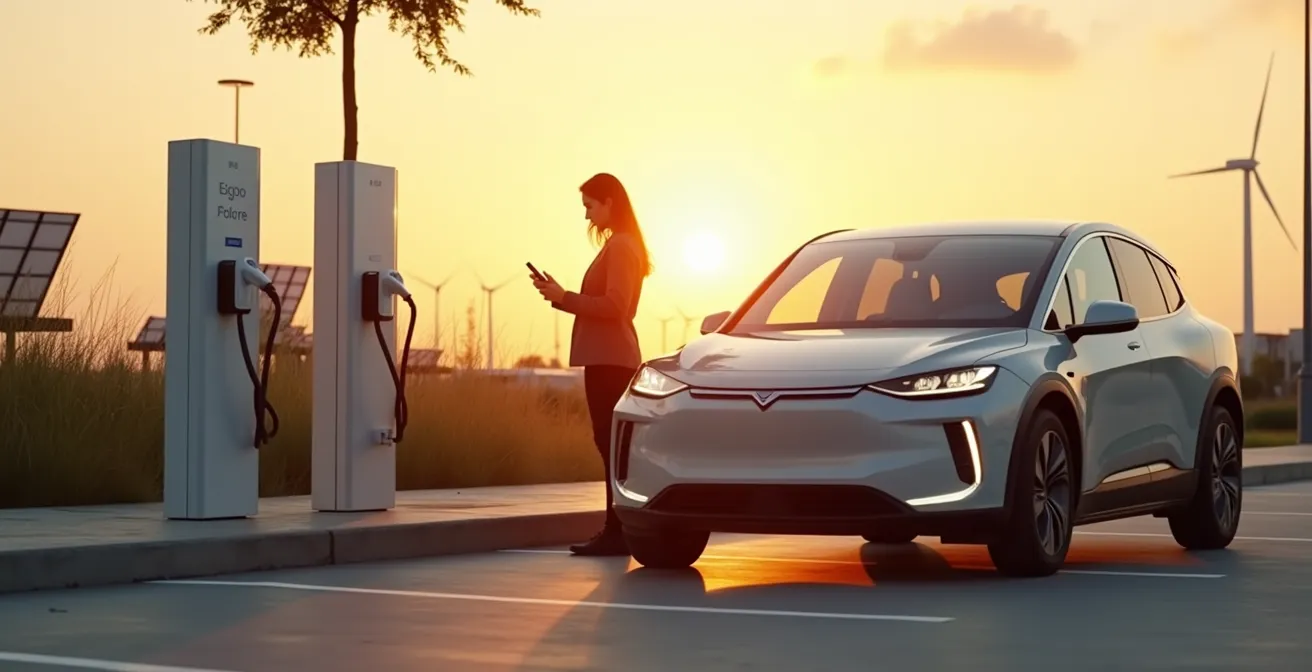
Switching to an EV is less about losing spontaneity and more about gaining intentional control over your daily mobility.
- Home charging becomes a simple, overnight ritual, not a daily chore you need to constantly think about.
- Your car’s software updates constantly improve it, turning a static object into an evolving digital device.
- Even your choice of supermarket can become a strategic decision based on the availability of free charging.
Recommendation: Focus on how an EV fits your current daily commute and routines, not on worst-case long-distance scenarios that rarely happen.
Making the leap to an electric vehicle (EV) often brings a wave of questions. Beyond the price and performance, potential buyers are most concerned about the fundamental changes to their daily lives. We’ve all heard the familiar refrains about “range anxiety” and the supposed hassle of meticulously planning every trip. Many guides focus on these perceived negatives, framing EV ownership as a series of compromises you must make.
But what if that perspective is outdated? The reality of living with a modern EV is far more nuanced and, for many, surprisingly freeing. The key isn’t just adapting to a new way of refueling; it’s about embracing a shift towards what can be called “intentional mobility.” This means your car, your home, and your daily schedule begin to work together as a single, smart energy ecosystem. It’s a transition from being a passive consumer of fuel to an active manager of your own energy resources, a change that brings unexpected efficiencies and a new sense of control.
This article will guide you through the practical, real-world habit changes that come with EV ownership. We will move past the myths and explore how the charging ritual, the digital nature of the car, and even long-distance travel planning are not burdens, but opportunities to build a smarter, more integrated lifestyle. We’ll examine the financial realities of depreciation, the choice between hybrid and full electric, and how to make the right decisions for your specific needs.
For those who prefer a visual format, the following video offers a glimpse into the future of the technology and trends we will be discussing. It complements the practical advice in this guide by showcasing the exciting direction in which the EV industry is heading.
To help you navigate these important considerations, this guide is structured to address the most pressing questions for prospective EV owners. The following summary outlines the key areas we will explore, providing a clear roadmap to understanding your new electric driving life.
Summary: A Roadmap to Your New Electric Driving Life
- Why EVs Have a Higher Carbon Footprint at Production but Win Over Time?
- How to Install a Level 2 Home Charger Without Upgrading Your Entire Electric Panel?
- Plug-in Hybrid or Full Electric: Which Is Better for Suburban Commuters?
- The Depreciation Risk: Will Today’s EVs Be Worthless in 5 Years?
- When to Buy an EV: Waiting for Solid State Batteries vs. Buying Now?
- The Route Mistake: Why Walking Along Busy Roads Negates Health Benefits?
- Why Cyber-Physical Systems Are the Backbone of Future Production?
- How to Plan Fast-Charging Stops for Trips Over 500km?
Why EVs Have a Higher Carbon Footprint at Production but Win Over Time?
One of the most common points of debate around EVs is their “carbon debt.” It’s true that manufacturing an electric vehicle, particularly its battery, is more energy-intensive than producing a gasoline-powered car. This initial environmental cost is a valid concern, but it only tells half the story. The real measure of a vehicle’s impact is its lifecycle emissions—from production to scrappage. Here, EVs have a clear and growing advantage.
The key concept to understand is the “break-even point.” This is the distance an EV must be driven for its zero tailpipe emissions to offset the higher emissions from its manufacturing. An analysis from the Union of Concerned Scientists found that this point is reached much sooner than many think. Depending on the vehicle model and the electricity grid’s cleanliness, the break-even point can be as low as 17,500 to 21,300 miles, a distance most commuters cover in under two years. After this point, the EV operates with a significant and growing carbon advantage for the rest of its life.

Furthermore, the industry is actively working to reduce the initial manufacturing footprint. Advances in battery chemistry are a major factor. For example, Lithium Iron Phosphate (LFP) batteries, which are becoming more common, have a much lower carbon footprint than traditional Nickel Manganese Cobalt (NMC) batteries. The International Energy Agency reports that LFP battery packs generate about one-third lower emissions, proving that the initial carbon debt is shrinking with every new technological advancement.
This long-term victory in emissions is a core part of the EV value proposition, turning the initial investment into a lasting environmental benefit.
How to Install a Level 2 Home Charger Without Upgrading Your Entire Electric Panel?
The idea of home charging is appealing, but the fear of a costly and complex electrical panel upgrade stops many potential buyers. While some older homes with limited capacity might require an upgrade, a growing number of smart solutions make it possible to install a powerful Level 2 charger using your existing setup. The key is not more raw power, but smarter power management.
First, it’s important to right-size your needs. According to data from the Department of Energy, the average American’s daily commute is under 40 miles. Most EVs can replenish that amount of energy in just a few hours on a Level 2 charger, and often overnight even on a standard wall outlet. This means you don’t need the absolute fastest charger on the market; you just need one that fits your daily “charging ritual.”
For those who need a Level 2 (240V) charger but have a full electrical panel, the solution is an energy management system or a “smart splitter.” These devices connect to the same circuit as another high-draw appliance, like an electric dryer or oven. The system intelligently monitors power usage; if the dryer is running, it pauses or reduces power to the EV charger to prevent an overload. Once the dryer cycle is finished, it automatically directs full power back to the car. This allows you to have the convenience of fast charging without the expense of rewiring your home.
Your Action Plan for a Smart Charger Installation
- Assess Panel Capacity: Start by having an electrician assess your current electrical panel’s capacity and identify high-draw appliances that share circuits, like a clothes dryer or water heater.
- Install a Smart Device: Choose and install a smart splitter or an energy management system that can dynamically adjust power distribution between the charger and another appliance.
- Configure Circuit Sharing: Configure the system to safely share a circuit with a designated appliance, ensuring the combined load never exceeds the circuit’s limit.
- Set Up Off-Peak Scheduling: Program your charger or vehicle to primarily draw power during off-peak hours (e.g., overnight) when other household appliances are not in use.
- Test System Stability: After installation, test the system by running the shared appliance while the car is charging to confirm that the power management works correctly and the circuit remains stable.
This approach transforms home charging from a potential barrier into a major convenience, making your garage the most reliable “gas station” you’ll ever use.
Plug-in Hybrid or Full Electric: Which Is Better for Suburban Commuters?
For suburban commuters, the choice between a plug-in hybrid (PHEV) and a full battery-electric vehicle (BEV) is a crucial one. A PHEV offers a “best of both worlds” approach with an electric motor for daily commutes and a gasoline engine as a backup for long trips, seemingly eliminating range anxiety. However, a BEV forces a more complete transition to the electric lifestyle, which can build more beneficial long-term habits.
The primary advantage of a BEV for commuters is its simplicity and lower total cost of ownership. With only one powertrain to worry about, maintenance is significantly reduced—no oil changes, fewer moving parts, and less to go wrong. While a PHEV offers flexibility, it also carries the complexity and maintenance costs of two separate systems. For a typical suburban commute, a modern BEV’s range of 200-300 miles is more than sufficient, making the gas engine in a PHEV largely redundant for daily driving.
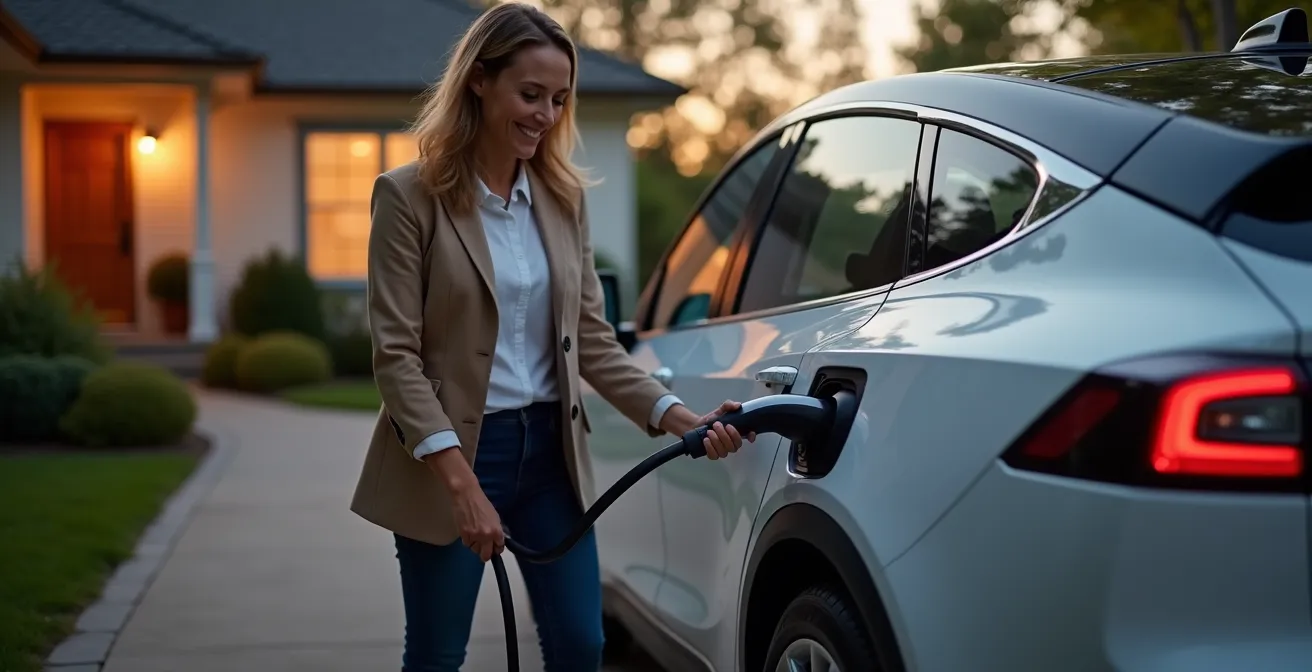
More importantly, committing to a BEV instills the discipline of the “charging ritual.” As the Quint’s research team notes, this shift in mindset is fundamental. They explain:
With an EV the discipline a driver needs to develop is to charge the vehicle like he or she would a mobile phone. If the vehicle has a 300 km range and daily commute is 50 km, it can be charged once every four days.
– The Quint Research Team, The Quint – Driving Skills for Electric Vehicles
This comparison to a smartphone is perfect. You don’t worry about your phone dying because you have a simple, established routine of plugging it in at night. A BEV encourages the same habit, making charging a thoughtless, automatic part of your day. The following table breaks down the key differences for a suburban driver.
This side-by-side comparison, drawn from an analysis of EV ownership factors, highlights the distinct advantages of each vehicle type for daily use.
| Factor | Plug-in Hybrid (PHEV) | Battery Electric (BEV) |
|---|---|---|
| Maintenance Complexity | Two powertrains to maintain (engine + battery) | Simplified single powertrain |
| Daily Range | 30-50 miles electric, unlimited with gas | 200-300+ miles electric only |
| Charging Discipline | Optional – can default to gas | Mandatory – forces habit building |
| Total Cost of Ownership | Higher due to dual system maintenance | Lower with reduced maintenance needs |
For most suburban commuters, the BEV’s simplicity and habit-forming nature make it the superior long-term choice for a truly integrated electric driving experience.
The Depreciation Risk: Will Today’s EVs Be Worthless in 5 Years?
Depreciation is a top concern for any new car buyer, but it feels especially potent with EVs due to the rapid pace of technological change. The fear is that buying an EV today means owning an obsolete piece of technology in five years, much like an old smartphone. While it’s true that battery technology is improving, the idea that today’s EVs will be “worthless” is an overstatement. The key to an EV’s long-term value lies in one primary component: its battery health.
Unlike a gasoline car, where value is tied to mileage and mechanical wear, an EV’s resale value is increasingly determined by the condition and remaining capacity of its battery pack. A well-maintained battery can retain a high percentage of its original capacity for well over a decade. This means that as a driver, you have a surprising amount of control over your car’s future value. By adopting battery-friendly habits, you can actively preserve your investment.
Furthermore, the growing battery recycling and reuse industry provides a crucial backstop for value. As batteries degrade, they aren’t simply thrown away. They are repurposed for stationary energy storage or recycled for their valuable raw materials. This burgeoning circular economy ensures that even an older EV battery has significant residual value, which will increasingly factor into the vehicle’s overall depreciation curve. The focus is shifting from a linear “use and discard” model to a circular “use and repurpose” ecosystem.
To maximize your EV’s long-term value, focus on these practical preservation tips:
- Set a Daily Charge Limit: For daily driving, set your charge limit to 80%. This simple, automated habit significantly reduces stress on the battery compared to charging to 100% every night.
- Minimize Fast Charging: Use DC fast chargers primarily for long-distance travel, not for daily top-offs. Frequent fast charging generates excess heat, which can accelerate battery wear over time.
- Avoid Extreme States of Charge: Try not to leave your car sitting for long periods with a full 100% charge or a very low charge (under 10%). A middle range is healthiest for the battery chemistry.
- Park in Moderate Temperatures: Whenever possible, park in a garage or shaded area to protect the battery from extreme heat or cold, which can cause thermal stress.
Ultimately, an EV’s value will be less about its model year and more about its proven battery health, giving informed owners a distinct advantage.
When to Buy an EV: Waiting for Solid State Batteries vs. Buying Now?
The world of EV technology is in constant motion, with tantalizing promises of future breakthroughs just over the horizon. The most prominent of these is the solid-state battery, which promises longer range, faster charging, and enhanced safety. This raises a critical question for any potential buyer: should you buy an EV now or wait for this “game-changing” technology to arrive? For most people, the answer is clear: the best time to buy is when you need a new car.
Waiting for the “perfect” technology is a trap that can leave you waiting forever. While solid-state batteries are promising, their mass-market availability is still several years away, and their initial rollout will likely be in high-end luxury models. The technology in today’s EVs is already mature, reliable, and more than capable of handling the needs of the vast majority of drivers. A modern BEV with a 250-mile range and efficient home charging is not a compromised “beta test”—it’s a fully realized product.
The decision to buy should be based on your current lifestyle and needs, not on speculation about the future. If your current car is aging, requires expensive repairs, or if you’re simply ready for a change, then today’s EVs offer compelling benefits in fuel savings, lower maintenance, and a superior driving experience. Waiting 3-5 years for a hypothetical improvement means missing out on those immediate benefits. Think of it like buying a computer: you could always wait for the next generation of processor, but you’d never actually get any work done.
Instead of focusing on a single future technology, consider the proven capabilities of what’s available now. For a commuter, the convenience of waking up to a “full tank” every morning and the quiet, smooth ride are transformative benefits you can enjoy today. Today’s EVs already solve the core problem of daily transportation cleanly and efficiently. Waiting for a perfect solution means missing out on a great one that’s available right now.
If an EV fits your budget and daily driving patterns today, there is little reason to postpone the switch for a technology that is not yet a market reality.
The Route Mistake: Why Walking Along Busy Roads Negates Health Benefits?
The title of this section might seem to be about pedestrian health, but in the context of EV ownership, it represents a deeper “route mistake”: sticking to old habits and destinations without considering the new opportunities your vehicle provides. The “negated benefits” aren’t about air quality, but about missing out on the financial and convenience perks of the EV ecosystem. The biggest shift in habit isn’t just how you drive, but where you decide to go.
EV ownership introduces a new variable into your decision-making: charging availability. Suddenly, a destination’s value isn’t just about the products it sells or the services it offers; it’s also about whether it can refuel your car while you’re there. This creates a new form of “value-driven destination” planning. A grocery store with free Level 2 chargers might become more appealing than a closer one without them. The cost of parking at a movie theater can be offset if it includes free charging, making it a smarter financial choice.
This change is perfectly captured by the experience of one new EV owner, who found their shopping and entertainment habits completely transformed:
Previously I’d shop at my nearest supermarket within walking distance. Now I drive 10-15 minutes to the supermarket across town because they have free EV chargers. I chose a basic theater with paid parking but free EV charging over a luxurious one, figuring my car might as well be doing something useful during the movie’s runtime. The presence of a free EV charger changed where I did those things.
– Tom’s Guide Contributor
This testimony reveals a profound shift. Travel is no longer just about getting from A to B; it’s about optimizing the time spent at B. This mindset extends to every part of the driving experience. Technologies like regenerative braking and one-pedal driving make you a more mindful and efficient driver, turning stop-and-go traffic from a frustration into an opportunity to recapture energy. You start seeing your entire travel ecosystem differently.
By integrating charging opportunities into your planning, you unlock a new layer of efficiency and value that owners of internal combustion engine vehicles simply don’t have.
Why Cyber-Physical Systems Are the Backbone of Future Production?
The term “cyber-physical system” sounds like something from a science fiction movie, but it’s the perfect description of a modern electric vehicle. And while the title mentions “future production,” it’s not about the factory floor—it’s about the ongoing “production” of your car’s features and performance long after it’s been built. An EV isn’t a static piece of machinery; it’s a powerful, connected device on wheels that constantly evolves.
This is perhaps the most profound habit change of all: you stop thinking of your car as a finished product. In the past, improving a car’s performance or adding a new feature required a physical trip to a dealership or mechanic. With an EV, these improvements are delivered directly to your car via over-the-air (OTA) software updates. Your car can gain efficiency, get faster acceleration, or receive new safety features while it’s parked in your driveway.

This digital integration forms the core of the driving experience. As one analysis of industry trends points out, EVs are becoming defined by their software. Navigation systems do more than just show a map; they provide real-time recommendations on where to charge, factoring in your battery level, traffic, and even the terrain to optimize your route. The car and its digital ecosystem are in constant communication, working to make your journey as seamless as possible.
Case Study: The Evolving Vehicle
By 2026, electric vehicles will function more like connected devices than traditional cars. As described by industry experts, over-the-air software updates allow manufacturers to continuously improve performance, efficiency, and safety features without requiring dealership visits. For the driver, this means the car they buy is not the best it will ever be; it’s a platform that gets better over time. Navigation systems integrated with the vehicle’s battery management offer real-time charging recommendations, traffic updates, and energy usage insights, making the car a proactive partner in planning your journey.
You are no longer just a driver; you are the user of a sophisticated piece of technology that is designed to improve with age.
Key Takeaways
- Initial Emissions Debt: EVs start with a higher carbon footprint from manufacturing but quickly “pay it back” and win on lifetime emissions, often within two years.
- Effortless Home Charging: The daily charging routine is best compared to charging your phone overnight—a simple, thoughtless habit that ensures you’re ready to go each morning.
- Value is in the Battery: An EV’s depreciation is primarily tied to its battery health, a factor that drivers can actively influence through smart charging and usage habits.
How to Plan Fast-Charging Stops for Trips Over 500km?
While most driving happens close to home, the occasional long-distance trip is where a little “intentional mobility” planning truly pays off. The goal of planning fast-charging stops is not just to get to your destination, but to do so efficiently and without stress. The key is to work *with* your car’s battery, not against it, by understanding its optimal charging curve.
A battery charges fastest when it’s at a low state of charge and slows down significantly as it approaches full. Therefore, the most efficient strategy for a road trip is to make more frequent, shorter charging stops rather than fewer, longer ones. Instead of running the battery down to 5% and charging all the way to 100%, it’s much faster to stop at 10-20% and charge only up to 80%. This keeps you in the “sweet spot” of the charging curve, minimizing your time spent waiting at the station.
This requires a mental shift away from the gasoline-car model of filling the tank to the brim. Modern EV navigation systems and third-party apps make this easy by planning routes based on charger availability and your car’s specific charging speed. They will often recommend a stop before you absolutely “need” one to ensure you arrive at the charger with the ideal battery level for maximum speed. Always identify one or two backup chargers near your planned stop in case the one you’re heading to is occupied or out of service.
Effective long-distance travel in an EV is a new skill, but it’s one that is quickly mastered. The core principles are:
- Arrive Low, Leave Early: Arrive at the fast charger with a low state of charge (10-20%) and plan to leave once you reach 80%, as the charging speed drops dramatically after that point.
- Plan for Stops, Not Range: Build your route around the strategic placement of reliable, high-speed chargers, not by trying to maximize every last mile of your car’s range.
- Anticipate the Road: Drive smoothly. Watch traffic ahead to coast rather than braking hard. This regenerative braking recaptures energy and extends your range between stops.
- Have a Backup Plan: For each planned charging stop, identify a nearby alternative. This simple step removes nearly all the anxiety from a long journey.
To see how these changes fit your specific needs, the next logical step is to analyze your daily commute patterns and identify the charging infrastructure available in your local area and on your most frequent long-distance routes.
Frequently Asked Questions About EV Driving and Charging
How does preconditioning help with long trips?
In hot weather, you can pre-condition your car by adjusting its temperature settings while it is still plugged in and charging. This means you get into a comfortable vehicle ready for your journey, and your battery’s power is conserved for driving instead of being used for climate control.
What driving style maximizes range on highways?
The faster you drive, the more energy you use. The best range comes from maintaining a consistent, moderate speed rather than engaging in high-speed driving. Driving smoothly and anticipating traffic to minimize hard braking also makes the car more efficient, as it allows the regenerative braking system to recapture more energy.