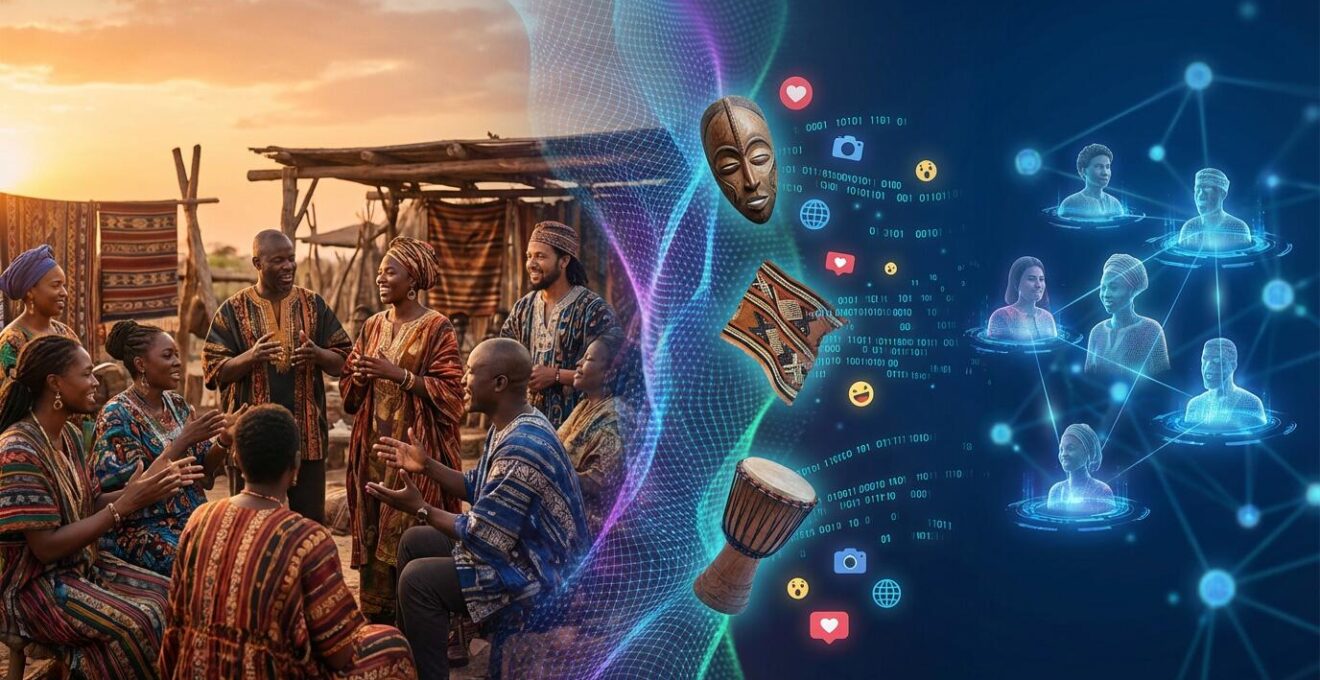
The common belief that algorithms create new behaviors is a misconception; they merely hijack and amplify our most ancient social drivers for connection and status.
- Digital platforms translate complex human desires into simple, quantifiable metrics (likes, shares), which in turn rewire our communication patterns.
- This process accelerates cultural homogenization, where global memes can overshadow local nuances, but also enables new forms of deep, asynchronous connection.
Recommendation: To navigate this new reality, we must shift our focus from blaming the technology to understanding and consciously managing the underlying human needs that these algorithms exploit.
We live in a world curated by unseen forces. The content we consume, the news we read, and even the slang our children use often feel like they emerge from the digital ether, shaped by algorithms we don’t understand. The common discourse points to the creation of “filter bubbles” and “echo chambers,” portraying technology as an external agent acting upon society. This view, however, only scratches the surface. It correctly identifies the symptom but misdiagnoses the cause, leading to a sense of powerlessness against an opaque and all-powerful machine.
The conventional wisdom suggests we fight the algorithm, seek out diverse content, and unplug more often. While well-intentioned, these solutions treat the technology as the primary problem. They overlook a more fundamental truth about the relationship between our digital tools and our innate human nature. The platforms are not inventing new desires within us; they have simply become ruthlessly efficient at identifying, quantifying, and exploiting the social drivers that have defined humanity for millennia: the need to belong, the desire for status, and the quest for connection.
But what if the real key to understanding our digitally-mediated world is not to focus on the code, but on the ancient human psychology it targets? This analysis proposes a shift in perspective. The true story of algorithmic influence lies in the process of algorithmic translation—how a platform converts a deep-seated human need into a measurable, scalable metric. By understanding this translation, we can move from being passive subjects of the algorithm to active architects of our digital and real-world interactions. This article will deconstruct this mechanism, exploring how it reshapes our language, our communities, and our very perception of reality, while offering strategies to foster more intentional connection in an age of automated influence.
This deep dive will explore the specific ways algorithms are re-engineering our social fabric. We will dissect everything from the evolution of language to the architecture of our online communities, providing a comprehensive framework for understanding this new cultural landscape.
Summary: How Algorithmic Systems Remodel Social Dynamics
- Why Global Memes Are Replacing Local Dialects Among Gen Z?
- How to Foster Deep Connection in Online Groups Without Physical Meetings?
- Emoji vs. Text: Which Communication Style Avoids Conflict in Global Teams?
- The Algorithmic Bias Error That Isolates You From Divergent Perspectives
- How to Design Hybrid Events That Respect Multiple Time Zones and Customs?
- Algorithmic Trust or Manual Targeting: Which Works Best on Facebook Ads Now?
- Why You Check Your Phone Unconsciously Every 10 Minutes?
- How Digital Mediums Preserve Global Heritage for Future Generations?
Why Global Memes Are Replacing Local Dialects Among Gen Z?
The erosion of local dialects in favor of a globalized digital slang is one of the most visible impacts of algorithmic culture. This isn’t a passive evolution; it’s a direct consequence of platforms designed to prioritize virality over context. Unlike previous generations who absorbed language through localized, peer-to-peer interaction, today’s youth are immersed in algorithmically curated feeds. A study reveals that 80% of Gen Z students acquire significant language skills from platforms like TikTok and Instagram, where content with the highest engagement potential is amplified globally, regardless of its origin.
This mechanism accelerates a phenomenon of cultural homogenization. Terms spread far beyond their original communities, often stripped of their cultural and historical significance. A prominent example is the widespread adoption of terms from African American Vernacular English (AAVE). As noted in an analysis of modern language, the rapid diffusion of AAVE terms through social media has led to new meanings detached from their original context, raising valid concerns about cultural appropriation. The algorithm does not teach the history or the nuance; it only registers the engagement signal and amplifies it.
This process highlights a fundamental shift in language acquisition. As the Kylian.ai Research Team observes in their work on Gen Z slang:
Unlike previous generations who learned slang through direct peer interaction, Gen Z acquires language through algorithm-driven feeds that prioritize engagement over education. Terms spread virally without accompanying cultural education, historical context, or usage guidelines.
– Kylian.ai Research Team, Gen Z and the Misunderstood Language of Slang
The result is a new global lexicon, optimized for brevity and visual impact, but often lacking the deep cultural roots that anchor local dialects. The algorithm, in its quest for universal engagement, inadvertently flattens the rich, textured landscape of human language into a more uniform, globally-palatable format. The loss isn’t just about words; it’s about the shared history and identity those words represent.
How to Foster Deep Connection in Online Groups Without Physical Meetings?
While algorithms can flatten culture, the same digital spaces can be intentionally designed to cultivate profound human connection. The challenge is to move beyond the superficial, reaction-based interactions favored by feeds and build environments that encourage depth and vulnerability. The key lies not in replicating physical meetings online, but in leveraging the unique strengths of digital communication, particularly the power of asynchronous depth—allowing members to contribute thoughtful responses on their own time.

As the visualization above suggests, true community is not about proximity but about the quality of the connections formed. Building these “glowing threads” in a virtual setting requires a deliberate architecture of interaction. Instead of open-ended chat channels that favor the loudest or fastest typists, a structured approach can create psychological safety and encourage more meaningful sharing. It’s about designing rituals and artifacts that build a shared history and a unique group identity, turning a collection of individuals into a cohesive community.
This requires a strategic shift from passive consumption to active co-creation. The community becomes a living entity, with its own language, inside jokes, and documented history. These digital artifacts serve as the virtual equivalent of shared physical memories, anchoring the group’s identity and reinforcing the bonds between members. By focusing on structured vulnerability and shared creation, online groups can achieve a level of connection that is not only comparable to but sometimes even deeper than what is possible in sporadic, face-to-face gatherings.
Action Plan: Building Authentic Online Community Bonds
- Create shared digital artifacts: Document inside jokes, group-specific memes, and key conversations in dedicated, easily accessible channels or documents.
- Prioritize structured vulnerability: Design asynchronous activities (e.g., weekly prompts) that encourage the sharing of personal narratives in a safe context.
- Leverage asynchronous depth: Use threaded conversations for complex topics to allow for more thoughtful, in-depth discussions rather than reactive chat.
- Build community-specific language: Actively cultivate and celebrate unique terms, acronyms, and expressions that strengthen the group’s distinct identity.
- Schedule ritual interactions: Establish regular virtual gatherings (e.g., weekly check-ins, monthly “show and tell”) with consistent formats and clear expectations.
Emoji vs. Text: Which Communication Style Avoids Conflict in Global Teams?
In global teams operating across different cultures and time zones, the choice between emoji and text is not merely stylistic; it’s a strategic decision that carries significant weight in preventing misunderstanding and conflict. The challenge lies in balancing clarity with emotional tone. Purely text-based communication, while precise, can be perceived as cold or harsh, stripping the message of crucial non-verbal cues. Conversely, emojis, intended to add emotional context, are notoriously prone to cultural misinterpretation.
The dilemma is rooted in a trade-off between cognitive load and ambiguity. Emojis have a low cognitive load—they are quick to send and process—but carry a high risk of ambiguity. A “thumbs up” emoji can mean “I agree” in one culture and be a grave insult in another. Text requires a higher cognitive load to write and read but offers significantly lower ambiguity, which is critical for complex tasks and feedback. A recent analysis shows that while 35% of Gen Z spend over 4 hours daily on social media, the communication styles learned there don’t always translate well to a professional, multicultural context.
The most effective solution is not to choose one over the other, but to establish a “context-specific charter.” This is a set of team-defined guidelines that explicitly state how and when to use emojis and what specific emojis mean within the group. This initial investment in creating a shared communication protocol dramatically lowers the risk of misinterpretation down the line. It acknowledges that neither text nor emoji is a perfect system and instead builds a third, bespoke system tailored to the team’s unique cultural makeup.
This comparative analysis highlights the risks and benefits of each communication style, reinforcing the need for a deliberate team-level strategy.
| Communication Type | Cognitive Load | Ambiguity Level | Best Use Case | Risk Factor |
|---|---|---|---|---|
| Emoji Only | Low | High | Social cohesion, quick acknowledgment | Cultural misinterpretation |
| Text Only | High | Low | Task instructions, feedback | Perceived coldness |
| Emoji + Text | Medium | Medium | Balanced communication | Inconsistent interpretation |
| Context-Specific Charter | Low | Very Low | Team-defined guidelines | Requires initial investment |
The Algorithmic Bias Error That Isolates You From Divergent Perspectives
The most discussed flaw in social media algorithms is their tendency to create “filter bubbles” or “echo chambers.” However, describing this phenomenon as a simple “bubble” is misleading. It’s not a passive enclosure but an active, dynamic process of reality-shaping driven by algorithmic bias. The system’s primary goal is to maximize engagement, and it quickly learns that the most reliable way to do this is by showing us content that confirms our existing beliefs and biases. This creates a powerful behavioral feedback loop.
This loop begins when the algorithm presents content. Our interaction—a click, a like, a share, or even just lingering for a few seconds—is registered as a positive signal. The algorithm then serves more content of a similar nature, reinforcing the initial preference. Over time, this process systematically filters out dissenting or divergent perspectives, not out of malice, but out of cold, mathematical efficiency. The system isn’t designed to educate or challenge; it’s designed to predict and satisfy our next click. The result is a distorted perception of the world, where our own views appear to be the overwhelming consensus.

The visual of a person surrounded by distorting mirrors accurately captures this experience. Each reflection represents a version of reality curated by the algorithm, showing us slightly different facets of what it thinks we want to see. The core self becomes lost in a kaleidoscopic hall of mirrors, each one reflecting a more extreme or simplified version of our original beliefs. Breaking free from this requires a conscious effort to seek out information that the algorithm has learned not to show us, effectively “polluting” its data set with unpredictable behavior to force it to present a wider view.
This isolation is the logical endpoint of a system that translates the human desire for validation into the metric of engagement. The algorithm gives us what we want to hear, and in doing so, it slowly insulates us from the complex, often contradictory, nature of reality. It’s a comfortable prison, but a prison nonetheless.
How to Design Hybrid Events That Respect Multiple Time Zones and Customs?
The rise of remote work has made hybrid events—with both physical and digital attendees—a necessity. However, a common failure is to simply livestream the physical event, creating a subpar experience for the remote audience. A truly successful hybrid event treats the two audiences as distinct but interconnected, designing separate journeys that cater to their unique contexts. This requires moving away from a single, synchronous moment and embracing a time-shifted synchronicity model.
The core of this model is the 24-hour event cycle. Instead of one keynote at a time that is inconvenient for most of the world, key content is rebroadcast or re-presented across major time zones (e.g., Americas, EMEA, APAC). This is supplemented by live, region-specific Q&A sessions and networking opportunities hosted by dedicated digital facilitators. This approach respects the time and attention of the global audience, acknowledging that their experience is just as important as that of the attendees in the room. The global reach of platforms like YouTube, where 88% of Gen Z users actively engage with content, demonstrates the massive appetite for accessible, on-demand content.
Furthermore, cultural integration is paramount. A truly global event must do more than just accommodate time zones; it must reflect the diversity of its audience. This means featuring speakers, case studies, and content from all represented regions. It also involves designing asynchronous networking channels, such as structured forums or dedicated Slack channels, that allow an attendee in Tokyo to have a meaningful conversation with a speaker in Berlin, long after the “live” session has ended. This transforms the event from a fleeting moment into a sustained, global conversation.
- Design two distinct experiences: Create separate but interconnected journeys for physical and digital attendees, with content tailored to each format.
- Implement 24-hour event cycles: Schedule key content rebroadcasts and live sessions across Americas, EMEA, and APAC zones to maximize accessibility.
- Establish dedicated digital hosts: Assign specific facilitators to engage with and support remote participants, ensuring they feel seen and valued.
- Create time-zone specific sessions: Offer regional Q&As and networking breakouts at optimal local times to encourage live participation.
- Build cultural integration: Intentionally feature speakers, moderators, and case studies from all represented regions to reflect the event’s global audience.
Algorithmic Trust or Manual Targeting: Which Works Best on Facebook Ads Now?
In the world of digital advertising, the central debate has shifted from creative versus budget to a more fundamental question: how much control should we cede to the algorithm? The choice between “algorithmic trust”—letting the platform’s AI find the audience—and “manual targeting”—defining the audience ourselves—is a strategic tightrope walk. Trusting the algorithm leverages machine learning’s power to analyze millions of data points, but it also means operating within a black box where biases can be amplified.
Platforms like LinkedIn and Facebook have become incredibly sophisticated. As one case study on social media advertising explains, LinkedIn’s algorithm tests content with a small sample audience and rapidly rewards posts that generate meaningful engagement. This “creative-as-targeting” paradigm means the ad creative itself does the work of finding the right people. If your ad resonates with a specific group, the algorithm will find more people like them. This approach is powerful but cedes significant control to a system whose ultimate goal is platform engagement, not necessarily your specific business outcome.
This is where the risk lies. An algorithm left to its own devices may optimize for metrics that are easy to measure but not aligned with true business goals. Worse, it can inadvertently tap into negative emotions to drive engagement. As Joe Burton, founder of the anit-extremism charity ‘Hope Not Hate’ points out:
Algorithmic biases could heighten engagement through fear, anger or outrage, inadvertently giving rise to extremist ideologies and making users vulnerable to radical content.
– Joe Burton, From clicks to chaos: How social media algorithms amplify extremism
The optimal strategy today is a hybrid one. It involves using manual targeting to set broad, strategic guardrails (e.g., geography, core interests) to define a “safe” playing field for the algorithm. Within that field, the advertiser can then trust the algorithm to find the pockets of highest engagement. It’s a partnership: human strategy sets the direction, and artificial intelligence optimizes the path.
Why You Check Your Phone Unconsciously Every 10 Minutes?
The unconscious habit of repeatedly checking our phones is not a sign of personal weakness or a lack of self-control; it’s the intended outcome of a system designed to hijack our deepest psychological needs. The compulsion is fueled by a powerful behavioral feedback loop that taps into what researchers call our “ancient human needs for connection and status.” Every notification, every like, every comment is a small, unpredictable reward that stimulates the same neural pathways as other addictive behaviors.
Research on digital habits reveals that 50% of Gen Z spend at least 4 hours daily on social media, an environment meticulously crafted to foster this dependency. The “pull-to-refresh” mechanism, the infinite scroll, and the red notification badges are all features of what is known as a “variable reward schedule.” We don’t know when the next reward (a like, a message) will come, so we are conditioned to check constantly. It’s the digital equivalent of a slot machine.

This entire ecosystem is built upon the foundational human motives that were essential for our survival. As a comprehensive review in a scientific journal explains, these platforms are so successful because they exploit our primal needs. As noted by Brady et al. in their research:
Social media and its algorithms are so successful because they build on ancient human needs for connection and status. The twin desires to get along and to get ahead are basic human motives that were crucial for survival in our ancestral environment.
– Brady et al., Social Drivers and Algorithmic Mechanisms on Digital Media
The algorithm translates our need “to get along” into likes and shares, and our need “to get ahead” into follower counts and influence metrics. The unconscious check is our brain seeking a quick hit of validation, a confirmation that we are still connected and that our status within the tribe is secure. Recognizing this mechanism is the first step toward reclaiming our attention.
Key Takeaways
- Algorithms don’t create behavior, they amplify pre-existing human social drivers for status and connection.
- The core mechanism is “algorithmic translation,” where complex desires are converted into simple, measurable metrics like ‘likes’.
- This process can lead to cultural homogenization but also enables new, intentional forms of deep community building if managed correctly.
How Digital Mediums Preserve Global Heritage for Future Generations?
While much of the discussion around algorithms focuses on their negative impacts, it’s crucial to acknowledge their profound potential as tools for cultural preservation and dissemination. Digital platforms, particularly video-sharing sites, have become vast, accessible archives of global heritage, democratizing access to knowledge and traditions that were once confined to specific geographies or academic institutions.
YouTube, for instance, has evolved far beyond an entertainment platform into a global learning commons. It serves as a living repository of cultural practices, from endangered languages and traditional crafts to historical footage and scientific experiments. As a Michigan State University analysis highlights, teachers use YouTube to bring complex concepts into classrooms and people of all ages turn to it for free, on-demand learning. A historical documentary, a tutorial on a traditional weaving technique, or a lecture from a world-class professor can be accessed by anyone with an internet connection, anywhere, anytime.
This creates an unprecedented opportunity for both preservation and cross-cultural understanding. A young person in a bustling city can learn the intricacies of a rural craft directly from a master artisan thousands of miles away. The algorithm, in this context, can act as a curator, connecting individuals with niche cultural content they would never have otherwise discovered. It allows for the preservation of not just the “what” of a cultural practice, but the “how,” capturing the human element of teaching and storytelling.
Of course, this digital archive is not without its challenges, including the risk of format obsolescence and the need for proper curation and contextualization. However, the sheer scale and accessibility of these platforms represent a monumental shift in how we document and transmit human culture. They are creating a dynamic, ever-expanding global heritage, ensuring that the knowledge and stories of our time are preserved for generations to come, not in dusty vaults, but in a living, breathing digital ecosystem.
Ultimately, navigating the world shaped by algorithms requires a conscious shift in our own approach. Instead of passively consuming what is served, the next step is to actively curate our digital environments and build communities with intention. This is how we can harness the power of connection while mitigating the risks of manipulation.