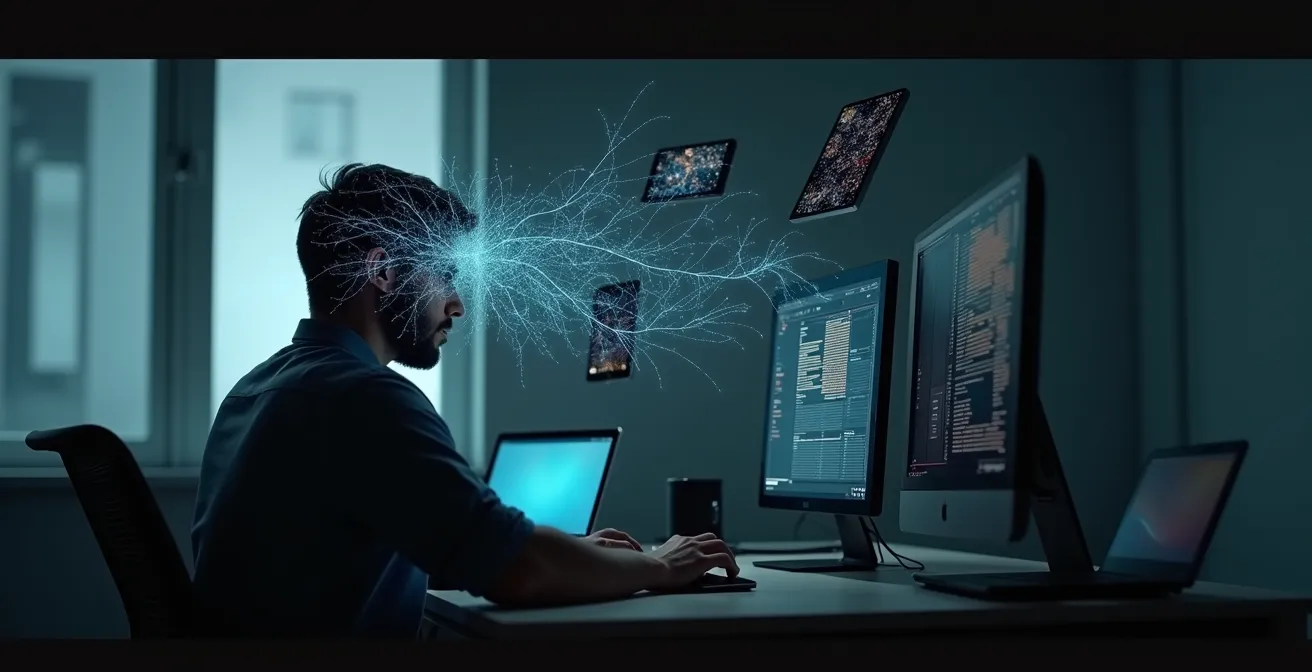
Contrary to popular belief, your inability to focus isn’t a failure of willpower; it’s a physiological response to the constant digital assault that has hijacked your brain’s core neurochemical systems.
- Constant notifications and unconscious checking create a dopamine-reward loop, mirroring the mechanics of addiction.
- This “digital noise” keeps your nervous system in a chronic “fight or flight” state, dysregulating the stress hormone cortisol.
Recommendation: To reclaim focus, you must first treat the problem not as a habit to be managed, but as neurological damage to be reversed through strategic periods of digital abstinence and environmental control.
You reach for your phone without thinking. You open an app, scroll for a moment, and put it down, only to realize you don’t even remember why you picked it up. This flicker of distraction, this fragmentation of thought, has become the default cognitive state for many knowledge workers. You feel it as a “goldfish attention span,” a persistent inability to engage in the deep, concentrated work that your profession demands. The prevailing wisdom offers simple solutions: turn off notifications, use time management apps, or practice “digital detoxes.” But these are surface-level fixes for a problem that runs much deeper.
These approaches fail because they treat the symptoms, not the cause. They operate on the flawed assumption that your dwindling focus is a matter of poor habits or weak self-discipline. The neurological reality is far more alarming. Your brain is not just distracted; it is being actively and systematically rewired by hyper-connectivity. Each ping, each vibration, each mindless scroll is a micro-dose of a powerful neurochemical cocktail that strengthens pathways for distraction while weakening those for deep thought. This isn’t a behavioral issue; it’s a physiological assault.
But if the damage is neurological, so is the solution. This article will abandon the platitudes of productivity gurus and instead offer a neuroscientist’s perspective. We will dissect exactly how constant connection hijacks your brain’s reward and stress systems, locking you in a cycle of anxiety and distraction. More importantly, we will outline a science-backed framework for reversing this damage, not by managing your device, but by healing your brain’s capacity for focus. It’s time to move beyond managing digital noise and start a regimen of neurological repair.
This guide will explore the precise mechanisms behind this cognitive decline and provide a clear, evidence-based path to reclaiming your focus. By understanding the neurological underpinnings of distraction, you can implement strategies that create lasting change.
Summary: The Neurological Impact of a Hyper-Connected World
- Why You Check Your Phone Unconsciously Every 10 Minutes?
- How to Reclaim 4 Hours of Focus Daily by Blocking Digital Noise?
- Moderation or Abstinence: Which Strategy Works for Long-Term Health?
- The Notification Error: Why Constant Pings Keep You in “Fight or Flight”?
- When to Turn Off Wi-Fi: The Critical Hour Before Sleep
- Why Your Cortisol Levels Spike After 6 PM Due to Digital Noise?
- The Over-Optimization Mistake: Trying to Learn While Resting
- Recognizing the Signs of High-Functioning Anxiety in the Workplace?
Why You Check Your Phone Unconsciously Every 10 Minutes?
That reflexive reach for your phone is not a conscious choice. It is the end result of a powerful, conditioned dopamine-reward loop established deep within your brain’s limbic system. Every notification, “like,” or novel piece of information acts as a small, unpredictable reward. Your brain releases a small hit of dopamine, the neurotransmitter of motivation and pleasure, reinforcing the behavior that led to the reward—in this case, checking your phone. Over time, this transforms a conscious action into an unconscious compulsion, a neurological itch that demands to be scratched. The sheer frequency of this cycle is staggering; studies from 2024 show people check their phones 205 times a day, which amounts to once every five minutes of waking life.
This mechanism is not merely habit-forming; it is structurally identical to the process of addiction. As Dr. Anna Lembke, Chief of Stanford’s Addiction Medicine Clinic, explains, the constant engagement is the core of the problem. Her clinical perspective is stark:
Texting friends, swiping dating profiles, even checking email, can all be engaging enough that they keep bringing users back for more. That’s the hallmark of an addictive drug.
– Dr. Anna Lembke, Chief of Stanford Addiction Medicine Dual Diagnosis Clinic
The problem is that, unlike a substance, the “drug” is omnipresent and socially sanctioned. Your brain becomes conditioned to seek novelty and stimulation from this external device, losing its ability to generate focus and engagement internally. The unconscious check is a symptom of a brain that has been trained to outsource its own reward system, leaving you in a state of perpetual, low-grade craving for the next digital hit.
How to Reclaim 4 Hours of Focus Daily by Blocking Digital Noise?
Reclaiming focus is not a battle of willpower fought moment to moment; it is a strategic campaign of environmental design. The most effective way to counteract the brain’s conditioned response is to remove the triggers from your environment entirely. This means creating “focus sanctuaries”—physical spaces and designated times where digital noise is physically inaccessible. The goal is to make deep work the path of least resistance. Instead of constantly fighting the urge to check your phone, you create a situation where the choice is already made for you. This frees up immense cognitive resources that would otherwise be spent on self-regulation.
Start by physically separating yourself from your devices. This could mean leaving your phone in another room while you work, using apps that block distracting websites for set periods, or even disabling your home Wi-Fi for a two-hour “deep work” block. The key is to create an insurmountable barrier between you and the source of distraction. This environmental control is not a sign of weakness but a strategic use of pre-commitment to protect your most valuable asset: your attention. The visual below illustrates an environment engineered for focus, where analog tools are prioritized and digital temptations are sequestered.

As this setup suggests, replacing digital tools with analog alternatives—a physical notebook instead of a notes app, a real timer instead of your phone’s clock—further solidifies this focus sanctuary. Each time you successfully complete a block of work without digital interruption, you are actively re-training your neural pathways. You are teaching your brain that focus itself is rewarding, slowly weakening the dopamine-reward loop tied to your phone and building a new, healthier one centered on sustained concentration and accomplishment.
Moderation or Abstinence: Which Strategy Works for Long-Term Health?
For a brain caught in a hyper-stimulation loop, the concept of “moderation” is often a trap. It’s like asking an alcoholic to have just one drink. The neural pathways are already primed for craving, and a small exposure can easily trigger a full-blown relapse into compulsive behavior. This is reflected in self-perception, where surveys show that nearly 48% of Americans consider themselves addicted to their phones. For these individuals, attempting to simply “use it less” requires immense and constant willpower, a finite resource that is quickly depleted, leading to failure and self-recrimination.
From a neuroscientific standpoint, the most effective initial strategy is a period of total abstinence. This is not a permanent lifestyle change but a therapeutic intervention designed to achieve a neurological reset. By completely removing the stimulus for a set period—be it a full day, a weekend, or even a week—you starve the overactive dopamine pathways. This allows the brain’s reward system to down-regulate and begin returning to its baseline sensitivity. Without the constant influx of digital rewards, your brain is forced to find satisfaction in more subtle, real-world stimuli, recalibrating what it considers “engaging.”
This approach is strongly advocated by addiction experts who see the parallels between digital and substance dependency. Dr. Anna Lembke recommends this form of “digital fast” as a clinical tool to reset the brain’s reward circuitry:
I recommend periods of total abstinence — up to a month if possible, but at least one day a week. Such phone vacations might reset the reward pathway.
– Dr. Anna Lembke, Stanford Addiction Medicine
After a successful period of abstinence, moderation becomes a more viable long-term strategy. With a reset baseline, you are better equipped to engage with technology intentionally rather than compulsively. The “one day a week” model, such as a “Tech-Free Sunday,” can serve as a regular maintenance routine to prevent the dopamine pathways from becoming over-sensitized again, ensuring lasting cognitive health.
The Notification Error: Why Constant Pings Keep You in “Fight or Flight”?
Every non-essential notification—a social media alert, a news update, a promotional email—is a false alarm for your nervous system. Your brain, evolved for a world of physical threats, cannot easily distinguish between a genuine emergency and a digital interruption. Each ping triggers a micro-burst of cortisol, the primary stress hormone. This is the biological basis of the “fight or flight” response. As Dr. Larry Rosen’s research has shown, even the absence of a phone can trigger this anxiety; when we put our devices down, our adrenal glands produce cortisol as our brain anticipates missing a crucial alert. We are conditioned to be in a state of hypervigilance.
This constant, low-grade activation of your stress response has devastating effects on cognitive function. Cortisol’s primary role in a crisis is to shut down non-essential functions, including the rational, slow-thinking processes of the prefrontal cortex, to favor rapid, instinctual reactions. When you are in a chronic state of digital alert, you are effectively living in a perpetual, low-level crisis. Your ability to think deeply, plan strategically, and regulate emotions is chronically suppressed. The result is a brain that is optimized for reaction, not reflection. This constant interruption fragments your attention, creating what is known as attentional residue—even after you’ve dealt with a notification, part of your cognitive bandwidth remains stuck on the previous task, preventing you from ever fully re-engaging.

This neurological degradation is quantifiable. A landmark Microsoft study revealed that the average human attention span dropped from 12 seconds in 2000 to just 8 seconds, less than that of a goldfish. This isn’t a moral failing; it’s the predictable outcome of a brain marinated in cortisol. Turning off all non-essential notifications is not a productivity hack; it is an act of neurological self-preservation, a critical step to pull your brain out of its state of manufactured emergency.
When to Turn Off Wi-Fi: The Critical Hour Before Sleep
The hour before sleep is the most critical period for digital disconnection. Exposure to screens during this window wages a two-front war on your brain’s sleep mechanisms. First, the blue light emitted from screens directly suppresses the production of melatonin, the hormone that signals to your body that it’s time to sleep. Second, and more insidiously, the content consumed—whether it’s checking work emails, scrolling through social media, or watching a dramatic show—keeps your brain in an activated, alert state, elevating cortisol levels precisely when they should be at their lowest.
This combination of suppressed melatonin and elevated cortisol disrupts the natural circadian rhythm, making it harder to fall asleep (increased sleep latency) and reducing the quality of sleep you do get. The impact is not trivial; scientific research shows that with more than 1 hour of screen time, the body’s natural cortisol regulation is significantly impaired. You may eventually fall asleep from sheer exhaustion, but you miss out on the deep, restorative stages of sleep necessary for memory consolidation, emotional regulation, and cellular repair. You wake up feeling groggy and unrefreshed, creating a greater need for stimulants like caffeine and a higher susceptibility to digital distraction the next day—a vicious cycle.
The solution is a strict “digital sunset.” This involves turning off not just your phone, but your Wi-Fi router one hour before your intended bedtime. This hard stop removes the temptation and the possibility of “one last check.” The benefits are immediate and measurable. A 2020 study demonstrated that when adults stopped all screen time 30 minutes before bed, their sleep latency was reduced by 12 minutes, and they slept for an average of 18 minutes longer. Instituting a full 60-minute buffer is an even more powerful intervention, giving your brain the crucial time it needs to lower cortisol, produce melatonin, and properly prepare for a night of true neurological recovery.
Why Your Cortisol Levels Spike After 6 PM Due to Digital Noise?
Under normal physiological conditions, your cortisol levels follow a natural diurnal rhythm: they peak in the morning to promote wakefulness and gradually decline throughout the day, reaching their lowest point in the evening to allow for sleep. However, evening exposure to digital noise completely derails this essential process. Engaging with screens, particularly with stimulating or stressful content like work emails or heated social media debates, signals to your adrenal glands that you are in a situation requiring alertness. This triggers an unnatural evening spike in cortisol.
This effect is compounded by the cumulative digital exposure throughout the day. Studies indicate that for individuals who spent more than 4+ hours per day on screens, baseline cortisol levels are already elevated, making them more susceptible to evening spikes. When your brain is already in a state of low-grade stress, any additional stimulus after 6 PM can push cortisol levels into a range that actively inhibits rest. This is not merely a feeling of being “wired”; it is a state of cortisol dysregulation. Your body is biologically awake when it should be powering down.
This phenomenon is particularly well-documented in adolescents, whose brains are more sensitive to these stimuli. Research on evening screen time in this group found it directly led to delayed sleep onset and more frequent awakenings during the night. These sleep disruptions are, in themselves, a form of stress that further elevates cortisol, creating a feedback loop of poor sleep and high stress. This evening digital engagement effectively flattens your natural cortisol curve, keeping you in a state of fight-or-flight when your body should be entering a state of “rest and digest,” severely compromising the restorative quality of your sleep and your cognitive function the following day.
The Over-Optimization Mistake: Trying to Learn While Resting
In our hyper-productive culture, even rest has become a target for optimization. We replace quiet moments with “valuable” content—listening to an educational podcast while walking, catching up on news during lunch, or watching a documentary to unwind. This is the over-optimization mistake: the belief that downtime must be filled with productive input to be worthwhile. From a neurological perspective, this is profoundly counterproductive. It denies the brain the one thing it needs to truly process information, consolidate memory, and generate creative insights: genuine, input-free rest.
When you are not focused on an external task, your brain activates a network known as the Default Mode Network (DMN). This is not an “off” state; it is a highly active and crucial mode of operation where the brain integrates past experiences, imagines the future, and solidifies learning. By constantly bombarding your brain with new information, you prevent the DMN from ever fully engaging. You are collecting data points but never allowing your brain the quiet space it needs to connect them into meaningful knowledge. True learning and creativity do not happen during information intake; they happen in the silent moments afterward.
To reverse this trend, you must intentionally schedule periods of “true rest” where the goal is not to consume, but simply to be. This means activities that are low-cognitive-load and do not involve structured information intake: going for a walk without headphones, sitting quietly with a cup of tea, or simply staring out a window. By embracing these moments of “unproductive” quiet, you are giving your brain the resources it needs to do its most important background work, leading to better memory, reduced anxiety, and more frequent “aha!” moments of insight.
Action Plan: Creating True Rest Cycles Without Digital Input
- Designate specific hours each day (e.g., 12-1 PM and 8-9 PM) to be completely phone-free zones.
- Use this protected time for analog activities like reading physical books, walking in nature, or mindful meditation.
- Replace mindless scrolling habits with activities that boost brain health, such as journaling or practicing a musical instrument.
- Establish permanent “no-phone” territories, making the bedroom and dining table sacred, screen-free spaces.
- Commit to learning a new physical skill (like juggling or a dance step) to build new neural pathways instead of reinforcing digital ones.
Key Takeaways
- Your “goldfish attention span” is not a personal failing but a physiological symptom of a brain rewired by a dopamine-driven reward loop.
- Constant digital pings trigger a chronic, low-grade “fight or flight” response, dysregulating the stress hormone cortisol and damaging deep focus.
- Reclaiming cognitive function requires treating the issue neurologically through strategic abstinence and environmental control, not just willpower.
Recognizing the Signs of High-Functioning Anxiety in the Workplace?
The neurological changes induced by hyper-connectivity often manifest in the workplace as high-functioning anxiety. This condition is insidious because, on the surface, the individual appears successful, productive, and highly engaged. They are the first to respond to an email, always available on Slack, and seemingly on top of every project. But beneath this veneer of productivity lies a nervous system in a constant state of hypervigilance. Their “responsiveness” is not driven by efficiency but by a deep-seated, cortisol-fueled fear of missing something important.
Key signs of high-functioning anxiety in a knowledge worker include an inability to fully disconnect after work hours, a compulsion to check email or work chats “just in case,” and a persistent feeling of impending doom if they are not immediately reachable. These individuals often overthink, procrastinate on deep tasks (favoring shallow, reactive work), and struggle with perfectionism. They may also exhibit physical symptoms like muscle tension, fatigue despite being “wired,” and difficulty sleeping. This constant state of alert is reinforced by the workplace environment, where the average American checks their phone 96 times during the workday alone.

This is the paradox of the modern workplace: the very behaviors that are rewarded—instant availability and rapid responsiveness—are also the behaviors that erode the capacity for the deep, innovative thinking that creates real value. Recognizing these signs in yourself or your colleagues is the first step toward addressing the root cause. It requires shifting the definition of a “good employee” from one who is always “on” to one who has the discipline to be strategically “off,” protecting their cognitive resources to deliver higher-quality work when they are focused.
Understanding the science is the first step. The next is taking action. Begin by auditing your own digital habits and identifying the primary sources of digital noise that elevate your stress and fragment your attention. Start with one small, decisive change—like turning off all non-human notifications or implementing a strict one-hour “digital sunset” before bed—to begin the process of reclaiming your cognitive sovereignty.