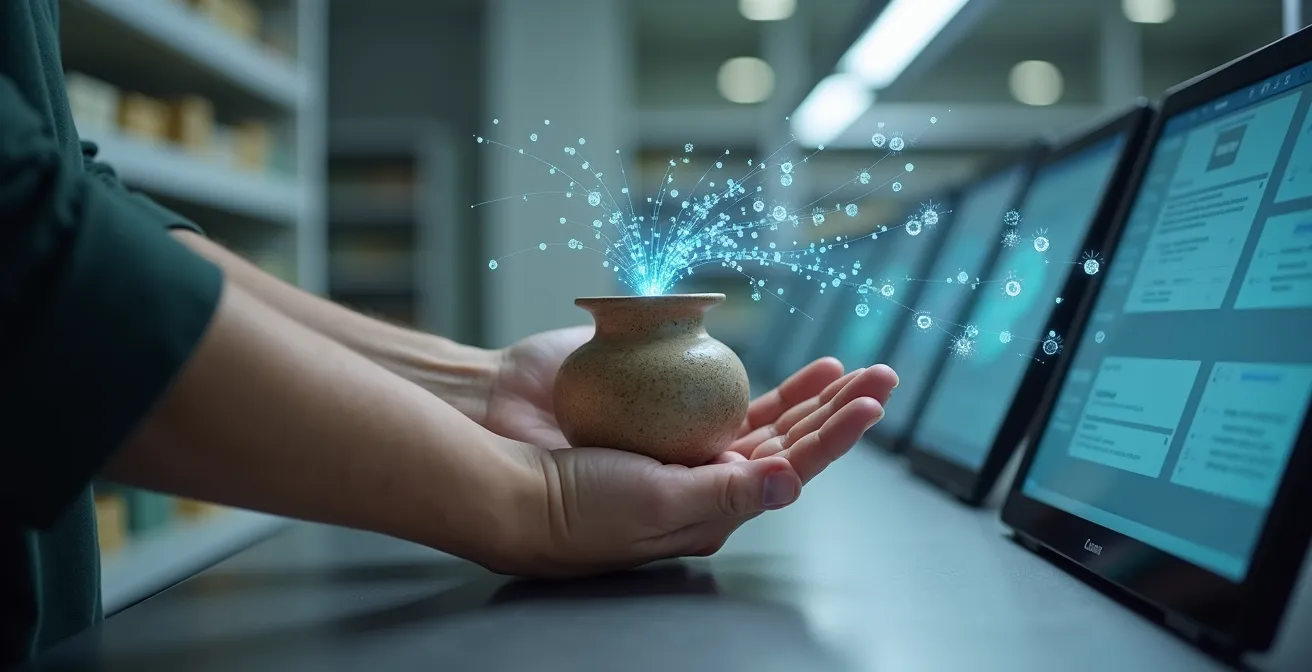
Effective digital preservation of cultural heritage is not merely a technological process but a series of critical curatorial decisions. The true value lies not in the act of 3D scanning, but in the strategic choices made about what to digitize, how to index the data for future discovery, how to license it for public access, and how to ensure its archival longevity. This shift from a tech-first approach to one of “digital stewardship” is what will genuinely safeguard our shared history for centuries to come.
The image of a priceless, fragile artifact, vulnerable to the ravages of time, conflict, or accident, is a familiar anxiety for any historian or museum curator. In response, the world of cultural heritage has enthusiastically embraced digital technologies. We are told that 3D scanning, virtual reality galleries, and vast digital archives are the definitive answers to the impermanence of our physical world. The common discourse often stops here, equating the act of digitization with the act of preservation.
However, this view is dangerously incomplete. This article argues that technology is merely the tool, not the strategy. The real work of a modern digital curator lies in the complex, nuanced decisions made before, during, and long after a scan is complete. If the fundamental key to safeguarding our past wasn’t the scanner, but the strategic wisdom guiding it? The most significant challenges are not technical, but curatorial: they involve ethics, accessibility, long-term financial planning, and a deep understanding of what makes data meaningful.
This guide will move beyond the superficial and explore the critical decision-making frameworks that underpin successful digital stewardship. We will delve into the strategic choices that transform a simple digital copy into a permanent, accessible, and meaningful part of our global heritage, examining everything from emergency digitization in conflict zones to the philosophical implications of open-access licensing.
Summary: A Strategic Framework for Digital Heritage Preservation
- Why 3D Scanning Is Crucial for Heritage Sites in Conflict Zones?
- How to Index Cultural Metadata for Universal Searchability?
- Restoration or Digitization: Which Prioritize for Decaying Artifacts?
- The Licensing Mistake That Restricts Access to Digitized Public Works
- How to Store Petabytes of 3D Scans Without Bankrupting the Museum?
- Why Global Memes Are Replacing Local Dialects Among Gen Z?
- Why an Email List Is Worth 10x More Than a Social Media Following?
- How Museums Use Immersive Augmented Reality to Engage Gen Z Audiences?
Why 3D Scanning Is Crucial for Heritage Sites in Conflict Zones?
In regions torn by conflict, cultural heritage is often a direct target. The deliberate destruction of historical sites is an attempt to erase a people’s identity and memory. In this context, 3D scanning transforms from a documentation tool into an act of cultural defiance and resilience. When physical preservation is impossible, digital preservation becomes the only viable path. The tragic events in Syria provide a stark example, where extensive documentation confirmed that over 40% of Palmyra’s historic buildings were destroyed or severely damaged between 2015 and 2017. These digital records are now the only remaining testament to much of what was lost.
This data serves a purpose far beyond mere archival. It becomes the foundational blueprint for future reconstruction, scholarly study, and collective memory. It ensures that even if a structure is turned to rubble, its form, texture, and cultural significance are not lost to oblivion. The goal is to create a “digital twin” so accurate that it can serve as a permanent proxy for the original.
Case Study: AI-Powered Reconstruction of the Temple of Bel
The ancient Temple of Bel in Palmyra, demolished by ISIS in 2015, stands as a powerful example of digital resurrection. Using a combination of tourist photographs, historical documents, and advanced 3D modeling methods, the UC San Diego Library’s Digital Media Lab undertook the monumental task of digitally reconstructing the temple. By employing artificial intelligence to stitch together disparate data sources, the team created a detailed and scientifically-grounded virtual model of the lost structure in 2020. This project not only preserves the memory of the Temple of Bel but also provides an invaluable resource for archaeologists and historians, demonstrating that digital tools can reclaim heritage even after its physical destruction.
Therefore, deploying rapid 3D scanning teams in at-risk zones is not an academic exercise; it is a critical form of cultural first-aid. It safeguards the legacy of a site against the worst-case scenario, providing a foundation of hope and data upon which future generations can rebuild.
How to Index Cultural Metadata for Universal Searchability?
A high-resolution 3D scan of an artifact, without context, is little more than a beautiful but mute digital object. It’s a file on a server, lost in a sea of data. Its true value is only unlocked when it is enriched with comprehensive metadata—the descriptive information that answers crucial questions: What is it? Where is it from? Who made it? What is its historical significance? Creating a robust metadata ecosystem is the difference between a digital junk drawer and a permanent, searchable global library.
The challenge lies in standardization. For a digital artifact in one museum’s collection to be discoverable and understandable by a researcher or system on the other side of the world, they must speak a common language. Adopting universal metadata standards is non-negotiable for true long-term preservation and accessibility. Without this, we risk creating thousands of isolated, incompatible digital silos, defeating the very purpose of digitization.
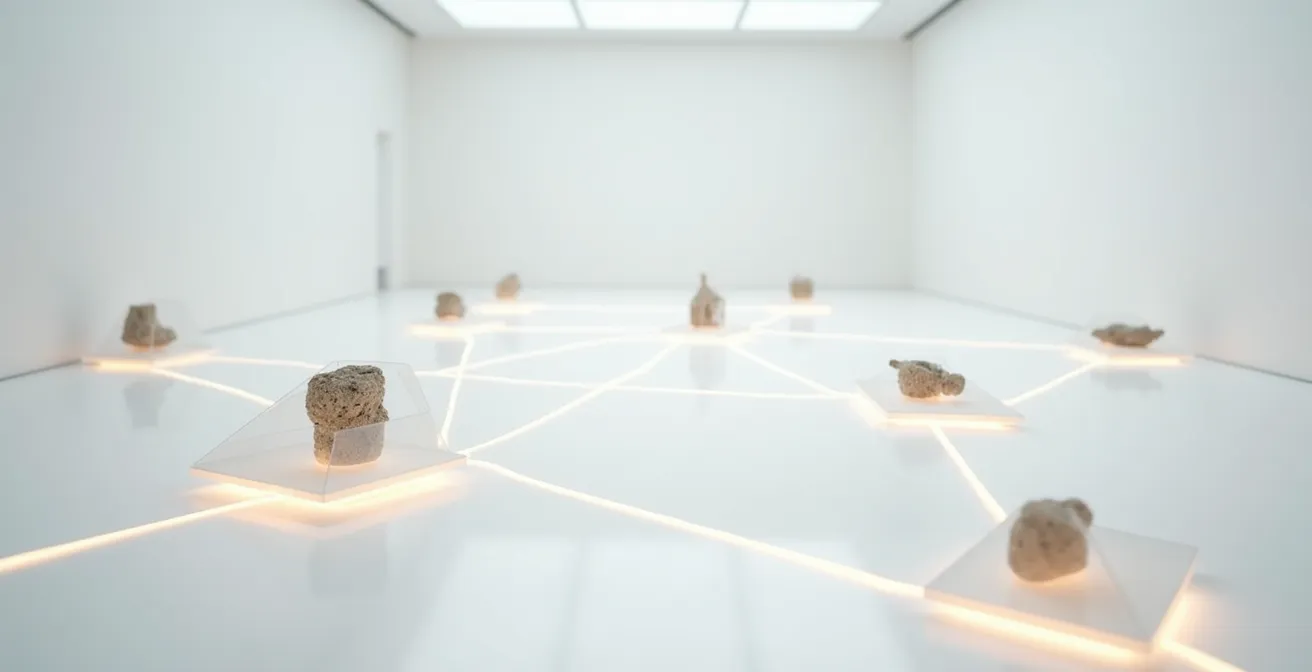
As this visualization suggests, the goal is to create a networked web of knowledge, where each object is a node connected to countless others through shared data. This semantic web allows for powerful new forms of discovery, enabling a user to trace an artistic style across continents or compare manufacturing techniques across centuries. Key standards that enable this interoperability include:
- CIDOC CRM: An ISO standard specifically designed to model the complex relationships within cultural heritage information.
- Dublin Core: A simpler, widely used set of terms for describing resources across different domains, ensuring basic interoperability.
- Linked Open Data (LOD): A set of protocols that allows data from different sources to be connected and queried, forming a global graph of knowledge.
- Decentralized Identifiers (DIDs): These create permanent, tamper-proof addresses for digital assets, ensuring a stable link to an object even if its location on a server changes.
Ultimately, investing in metadata is as important as investing in the scanning technology itself. It is the curatorial act of providing context, provenance, and meaning, ensuring that the objects we save digitally can continue to tell their stories for generations to come.
Restoration or Digitization: Which to Prioritize for Decaying Artifacts?
When faced with a fragile, decaying artifact, a curator confronts a difficult choice: allocate limited resources to immediate physical restoration, or prioritize creating a perfect digital copy? This isn’t just a practical question; it’s a philosophical one. Physical restoration is an intervention, often irreversible, that aims to stabilize the object for the present. Digitization is a non-invasive act of documentation that aims to preserve a snapshot of the object for eternity. Each path has profound implications for cost, time, and accessibility.
The decision is rarely binary. Increasingly, a hybrid model is emerging as the most responsible approach. This strategy, known as “digital-first preservation,” advocates for creating a high-fidelity 3D scan before any physical conservation work begins. This digital twin serves as a crucial baseline—a perfect record of the object’s state, including its decay—that can inform and guide the subsequent physical restoration. Furthermore, digitization dramatically reduces the need for physical handling, significantly mitigating wear and tear on fragile originals.
One of the central debates in this field is authenticity. Is a digitally-reconstructed or color-corrected version of an artifact “real”? The answer is that it’s a new kind of real—an informed interpretation based on scientific data. It does not replace the original but exists alongside it as a vital layer of understanding. The following table breaks down the core trade-offs:
| Approach | Cost | Time Frame | Reversibility | Access |
|---|---|---|---|---|
| 3D Digitization | $500-5000/object | 1-3 days | Non-invasive | Global digital access |
| Physical Restoration | $5000-50000/object | Weeks to months | Often irreversible | Limited to location |
| Hybrid Model | Variable | Phased approach | Digital first, then guided physical | Both digital and physical |
By prioritizing digitization, institutions are not abandoning their physical collections. Instead, they are making a strategic investment in their long-term future, creating a safety net of data that ensures the artifact’s story will survive, regardless of its physical fate.
The Licensing Mistake That Restricts Access to Digitized Public Works
Perhaps the most counter-intuitive failure in digital preservation is the “last-mile problem”: an institution spends immense resources to digitize a public domain work, only to lock it away behind restrictive copyright claims. This creates a digital paradox where an artifact that was freely accessible in the physical world becomes restricted in the digital one. This is more than a legal oversight; it’s a philosophical failure to embrace the full potential of digitization, which is to democratize access to culture.
The solution lies in adopting an open access philosophy, most powerfully expressed through Creative Commons licenses, particularly the Public Domain Dedication (CC0). By applying a CC0 license, an institution legally waives all copyright claims to the digital copy, placing it as freely into the public domain as the original artifact. This act unlocks a cascade of benefits, allowing educators, artists, researchers, and the public to use, remix, and build upon the collection without restriction. Research from Global Digital Heritage shows that museums adopting open licenses can see a staggering 300% increase in the use of their collection’s digital surrogates.
Choosing a restrictive license is often rooted in outdated funding models or a misplaced fear of losing control. However, leading institutions have proven that openness generates more value—in terms of public engagement, academic collaboration, and global relevance—than any licensing fee ever could.
Case Study: The Rijksmuseum’s Open Access Revolution
The Rijksmuseum in Amsterdam is a global leader in open access. Years ago, it took the bold step of making high-resolution images of its public domain masterpieces, including Rembrandt’s “The Night Watch,” available for free under a CC0 license. Rather than seeing their revenue or authority diminish, the museum witnessed an explosion of creative reuse. Their collection appeared on everything from clothing to advertisements, dramatically increasing the museum’s global visibility and public engagement. This success story proves that the most valuable asset is not the digital file itself, but the cultural impact it can have when set free.
The curatorial decision regarding licensing is therefore not a technical footnote. It is a defining statement about the institution’s mission: is it a gatekeeper of culture, or a facilitator of it?
How to Store Petabytes of 3D Scans Without Bankrupting the Museum?
The greatest unseen challenge in digital preservation is the sheer, crushing weight of data. Digitizing an entire collection creates a data tsunami. As noted in recent museum digitization studies, a single high-resolution 3D scan can range from 1GB to 10GB. Multiply that by thousands of artifacts, and institutions are suddenly responsible for petabytes of data. The question of how to store this data securely, accessibly, and affordably over decades—or even centuries—is one of the most pressing problems in the field. Simply buying more hard drives is not a sustainable strategy.
The key to archival longevity is a tiered storage strategy. This approach recognizes that not all data needs to be instantly accessible. By classifying files based on their intended use, museums can assign them to different storage tiers with vastly different cost structures. This prevents institutions from paying a premium for instant access to master files that may only be retrieved once every few years. It’s a strategic allocation of resources that balances accessibility with fiscal reality.

This layered architecture is essential for a sustainable digital future. The master files, the pristine “digital negatives,” must be protected above all else, while more accessible, compressed copies serve the daily needs of researchers and the public. This ensures both long-term integrity and immediate utility without breaking the budget.
Action Plan: Implementing a Tiered Storage Strategy
- Identify Master Files: Isolate the original, uncompressed, high-resolution scans. These are your most valuable digital assets.
- Select Cold Storage: Transfer these master files to an archival “cold storage” service (like AWS Glacier). This is extremely low-cost storage for data that is rarely accessed but must be preserved.
- Create Production Copies: Generate optimized, but still high-quality, versions for active use by researchers. Store these in “warm” storage, which offers a balance between cost and retrieval speed.
- Deploy Access Copies: Create lightweight, compressed versions (e.g., smaller JPGs or lower-poly 3D models) for public-facing websites. Host these on a Content Delivery Network (CDN) for fast global access.
- Audit and Migrate: Establish a regular schedule (e.g., every 5-10 years) to audit file formats and migrate data to new storage media to prevent format obsolescence and data degradation.
By moving away from a one-size-fits-all approach, museums can build a storage infrastructure that is both resilient and financially sustainable, ensuring the digital collection survives for the long haul.
Why Global Memes Are Replacing Local Dialects Among Gen Z?
At first glance, the ephemeral nature of internet memes seems to be the antithesis of timeless cultural heritage. However, to a digital curator, they represent a fascinating and vital new form of modern digital folklore. Memes, with their shared visual language, rapid evolution, and cultural specificity, function in much the same way as traditional folklore or local dialects. They are a medium through which communities express shared values, humor, and identity. The concern that this global, visual language is supplanting hyper-local linguistic diversity is a valid one, but it also presents an opportunity.
The same tools and ethical frameworks used to preserve ancient manuscripts can and should be applied to born-digital cultural phenomena. Archiving memes is not a frivolous act; it is the work of documenting the intangible cultural heritage of the 21st century. It requires capturing not just the image or video, but its context: its origin, its mutations, and the conversations it sparked. This is critical because digital culture is incredibly fragile. A broken link, a deleted account, or a defunct platform can erase a significant cultural moment forever.
Memes are a form of modern digital folklore that can be archived using the same preservation tools as traditional heritage.
– Digital Culture Researchers, Journal of Digital Anthropology
Furthermore, the mechanics of meme culture—sharing, remixing, and forwarding—offer valuable lessons for heritage institutions. Recent studies show that over 50.44% of audiences who engage with cultural heritage content online will share or forward it. This viral potential, perfected by meme culture, is a powerful force that museums can harness. By understanding why a meme goes viral, institutions can learn how to make their own content more shareable, engaging a new generation in a language they understand fluently.
Why an Email List Is Worth 10x More Than a Social Media Following?
In the quest for public engagement, many cultural institutions have poured significant resources into building large followings on social media platforms. While these platforms are valuable for visibility, relying on them exclusively is a strategic error. A social media following is a rented audience; the institution is subject to the whims of algorithms, changing platform policies, and the risk that the platform itself becomes obsolete. A digital curator, concerned with long-term relationships, must recognize the superior value of an owned asset: the email list.
An email list is a direct line of communication to your most dedicated supporters. It is a “digital congregation”—a community you have built and can engage with directly, without an intermediary. Each subscriber has explicitly opted in, signaling a deeper level of interest than a casual “like” or “follow.” This direct relationship is invaluable for fostering a sense of community, sharing in-depth stories that don’t fit into a tweet, and building long-term financial support through fundraising campaigns.
From a digital stewardship perspective, an email list is an archive of relationships. It is a dataset of your core community that belongs to the institution, not to a tech company in Silicon Valley. While social media is excellent for attracting new audiences at the top of the funnel, the email list is where you cultivate the deep, lasting connections that are the lifeblood of any cultural organization. It is a stable, reliable asset in a volatile digital landscape. The effort to convert a fleeting social media follower into a dedicated email subscriber is one of the most important investments an institution can make in its future.
Building this community is not just about sending newsletters. It is about providing consistent value, sharing exclusive content, and creating a sense of belonging. It is the digital equivalent of nurturing a relationship with a major donor—it requires care, attention, and a long-term perspective.
Key Takeaways
- Digital preservation is a curatorial act, not just a technical one. The most important work involves strategic decision-making.
- Openness is a force multiplier. Adopting open-access licenses for public domain works dramatically increases their global impact and engagement.
- A tiered storage strategy is essential for managing the massive data footprint of digitization in a financially sustainable way.
How Museums Use Immersive Augmented Reality to Engage Gen Z Audiences?
After an artifact has been scanned, indexed, and archived, its digital twin can be brought to life in powerful new ways. For a generation of digital natives like Gen Z, who navigate the world through their screens, Augmented Reality (AR) offers a transformative bridge between the physical museum space and the rich digital information we’ve so carefully preserved. AR is not a gimmick; it is a powerful storytelling tool that can make history tangible, interactive, and personally relevant. According to recent museum technology studies, institutions using AR have reported up to a 65% increase in engagement from younger visitors.
Instead of just viewing an ancient pot behind glass, a visitor using a smartphone or AR glasses can see it digitally reassembled from shards, watch a holographic potter demonstrate how it was made, or see its original contents appear inside. This “contextual overlay” answers the silent question in every visitor’s mind: “What’s the story behind this?” It transforms passive viewing into active discovery, catering directly to the exploratory and interactive learning styles of younger audiences.
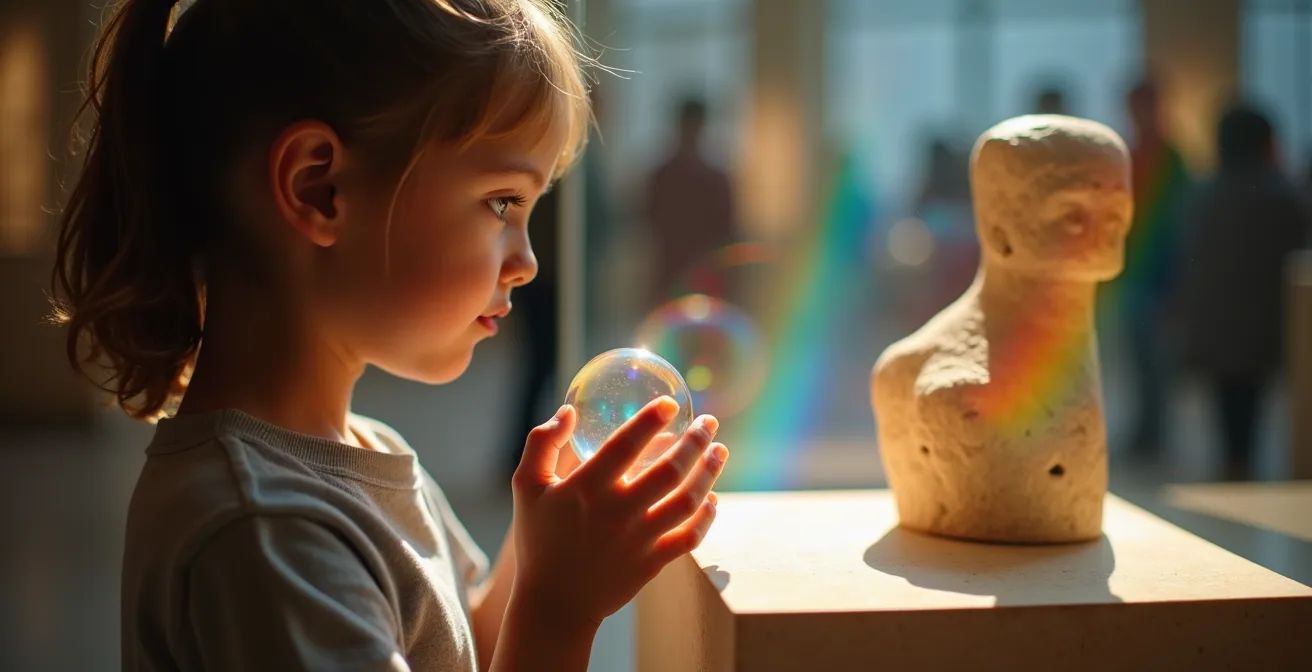
The implementation of AR can range from simple mobile apps to highly immersive, room-scale experiences. The choice of technology depends on the institution’s budget and storytelling goals. Each level offers a unique way to leverage the underlying digital assets to create a more profound connection between the visitor and the object.
| Technology | Use Case | Engagement Level | Cost |
|---|---|---|---|
| Mobile AR Apps | Object information overlay | Moderate | $10K-50K |
| AR Glasses | Immersive historical reconstructions | High | $50K-200K |
| Projection Mapping | Room-scale experiences | Very High | $100K+ |
Augmented reality represents the final, crucial step in the digital preservation lifecycle: activation. It is where the carefully preserved data is unleashed to create moments of wonder and understanding, ensuring that the stories of our shared past will not only be saved but will also continue to inspire and resonate with the generations of the future.
Begin by auditing your institution’s current digital strategy, not as a technical checklist, but as a set of curatorial decisions that will define its legacy for generations to come.