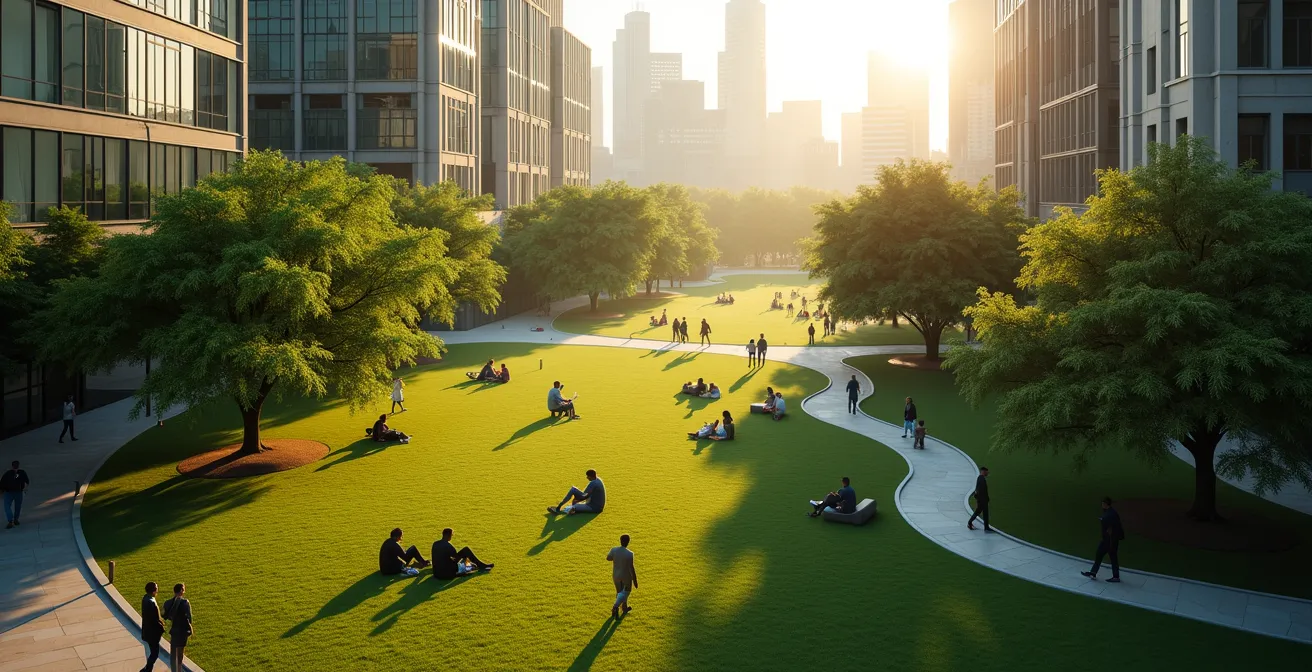
Believing that any green space can reduce stress is a common misconception. The key lies not in the mere presence of nature, but in how our brains consciously interact with its specific patterns and sounds.
- Visual exposure to natural fractal patterns, like those in leaves and branches, actively lowers physiological stress.
- Immersive experiences in green corridors, away from traffic noise, are essential for true cognitive restoration.
Recommendation: Intentionally seek out environments with high biophony (natural sounds) and visual complexity (diverse plants) to maximize mental health benefits.
For the millions feeling the squeeze of urban life, the city can feel like a relentless concrete labyrinth. The constant hum of traffic, the visual clutter of advertisements, and the sheer density of the population create a low-grade, chronic stress that drains our mental and emotional resources. In response, the common advice is simple: “get out into nature.” We flock to parks and greenways, seeking a moment of peace, believing that any patch of green is a sufficient antidote to the urban grind.
While well-intentioned, this advice often misses the deeper mechanism at play. The restorative power of nature isn’t just about escaping concrete; it’s a profound neurological process. Many urbanites try to incorporate nature by jogging along busy boulevards lined with a few trees or placing a single succulent on their desk, only to find the calming effects minimal or fleeting. They are engaging with the idea of nature, but not with the specific sensory inputs that trigger genuine cognitive restoration.
But what if the true key to unlocking nature’s benefits lies not in the *quantity* of green space, but in the *quality* of our interaction with it? This article moves beyond the platitudes to explore the science of how our brains respond to the natural world. We will reveal that the solution to urban stress is more nuanced than simply “seeing green.” It involves consciously engaging with specific natural patterns, sounds, and rituals that actively heal our overstimulated minds.
By understanding these mechanisms, from the power of fractal patterns to the importance of sensory landscapes, you can transform how you experience your urban environment. This guide will provide actionable strategies to turn every sliver of nature—from a window view to a community garden—into a powerful tool for well-being.
Summary: The Science of Urban Sanctuaries: A Guide to Reducing City Stress
- Why Seeing Trees Out Your Window Lowers Your Blood Pressure?
- How to Choose Air-Purifying Plants That Survive in Low Light Offices?
- Walking to Work or Treadmill: Which Exercise Better Clears the Mind?
- The Route Mistake: Why Walking Along Busy Roads Negates Health Benefits?
- How to Use Community Gardens to Combat Loneliness on Weekends?
- How to Create a Physical Workspace That Signals “Off-Duty” to Your Brain?
- Why EVs Have a Higher Carbon Footprint at Production but Win Over Time?
- How Hyper-Connectivity Rewires the Brain’s Ability to Focus Deeply?
Why Seeing Trees Out Your Window Lowers Your Blood Pressure?
The calming effect of a natural view is not mere poetry; it is a measurable physiological response rooted in how our brains are wired to process visual information. For millennia, we evolved in environments rich with the intricate, repeating geometries of nature. These forms, known as fractal patterns, are found everywhere from the branching of a tree and the veins of a leaf to the structure of a snowflake. Our visual system has become exceptionally efficient at processing them, an act that is inherently effortless and deeply soothing.
When you gaze at a tree, your brain isn’t just seeing “green.” It’s absorbing a complex tapestry of self-similar patterns. This effortless processing induces a state of wakeful relaxation, decreasing activity in the stress-processing regions of the brain. Research from the University of Oregon demonstrates that 60% of stress reduction is attributable to simply viewing these computer-generated fractal images. This explains why a view of a single, complex tree can be more restorative than a vast, featureless lawn.
The long-term impact of this passive exposure is profound. A landmark nationwide study in Denmark, which tracked nearly a million citizens, revealed a powerful correlation between childhood exposure to green space and adult mental health. The findings, analyzed using decades of satellite data, were startling: individuals who grew up with the least green space nearby had as much as a 55 percent increased risk of developing psychiatric disorders like depression and anxiety later in life. This suggests that the consistent, low-level cognitive restoration provided by natural views builds a foundational resilience against mental health challenges.
Therefore, the simple act of having a window that looks out onto natural scenery is not a luxury, but a form of preventative healthcare. It provides a constant, passive dose of cognitive ease that counteracts the demanding, hard-edged geometry of the urban environment, directly contributing to lower blood pressure and a more balanced nervous system.
How to Choose Air-Purifying Plants That Survive in Low Light Offices?
Bringing nature indoors is a popular strategy for humanizing sterile office environments, but its success hinges on more than just adding a splash of color. The true biophilic benefit comes from creating a micro-ecosystem that enhances air quality, provides visual restoration, and even increases perceived privacy. The challenge in most offices is the low-light conditions, which can doom many popular houseplants. The key is to select resilient species that thrive in the shade and to place them strategically to maximize their psychological impact.
Forget delicate flowers and think in terms of texture, form, and resilience. Plants like the Snake Plant (Sansevieria trifasciata), ZZ Plant (Zamioculcas zamiifolia), and Cast Iron Plant (Aspidistra elatior) are champions of low-light survival. They are not only tolerant of infrequent watering and fluorescent lights but also possess strong, structured leaves with compelling fractal patterns. These plants excel at filtering common indoor air pollutants like formaldehyde and benzene, contributing to a healthier physical environment while their visual complexity offers the same stress-reducing benefits as an outdoor view.

As the image above illustrates, the placement of these plants is as important as their selection. Instead of a single, isolated pot, grouping plants can create soft visual barriers in open-plan offices. This subtly increases a sense of personal space and privacy, reducing the feeling of being constantly exposed and monitored. Arranging several species together also mimics the complexity of a natural undergrowth, providing a richer visual field for your eyes to rest on during micro-breaks.
Action Plan: Your Strategic Biophilic Placement Audit
- Points of Contact: Identify all areas in your workspace where plants could be seen from your desk, especially in your peripheral vision.
- Collect & Inventory: Choose 2-3 different low-light species (e.g., Snake Plant, ZZ Plant, Pothos) to create visual diversity.
- Coherence & Function: Position taller plants to act as soft visual barriers, defining your workspace and increasing perceived privacy from walkways or other desks.
- Memorability & Emotion: Prioritize plants with visible fractal patterns, such as ferns or succulents, and place them within your direct line of sight for effortless “micro-restorations.”
- Integration Plan: Ensure every workstation has a clear view of at least one plant grouping to provide consistent access to these restorative visual elements throughout the day.
By shifting the focus from mere decoration to strategic biophilic design, even the most light-deprived office can become a more restorative and productive environment. It’s about curating a resilient indoor nature that actively works for your well-being.
Walking to Work or Treadmill: Which Exercise Better Clears the Mind?
Both a brisk walk to work and a session on the treadmill burn calories, but when it comes to mental clarity, the context of the exercise is everything. A treadmill run bombards the brain with the monotonous drone of the motor and the harsh, repetitive visual of a gym wall. In contrast, a walk through a park or along a tree-lined street engages the mind in a completely different, and far more restorative, way. The difference lies in a concept known as Attention Restoration Theory (ART).
Our brains have two main types of attention: directed attention, which we use for focus-intensive tasks like working or driving, and involuntary attention, which is effortlessly captured by inherently fascinating stimuli. Urban life constantly taxes our directed attention, leading to mental fatigue. A treadmill workout, requiring conscious effort to maintain pace, does little to replenish it. A nature walk, however, is rich in stimuli that engage our involuntary attention—the rustle of leaves, the pattern of light through branches, the sound of birdsong. This “soft fascination” allows our directed attention to rest and recharge.
This is not just a theoretical difference; it has measurable physiological effects. While any exercise can help manage stress, outdoor activity in a natural setting provides a significant extra benefit. Studies on the effects of green exercise show that just 90 minutes twice weekly in nature measurably improves cortisol levels, the body’s primary stress hormone. The varied sensory input and the engagement of soft fascination actively down-regulate the nervous system in a way that indoor exercise cannot replicate.
The architects of Attention Restoration Theory, Kaplan and Kaplan, articulated this phenomenon perfectly in their research published in Nature Scientific Reports:
Attention Restoration Theory suggests that visiting natural environments such as urban green space and parks reduces stress by stimulating involuntary attention and thereby reducing directed attention.
– Kaplan and Kaplan, Nature Scientific Reports
Ultimately, while a treadmill provides a physical workout, a walk through a green space provides a cognitive workout. It cleanses the mental palate, reduces the cognitive load, and replenishes the very mental resources needed to tackle the complexities of the workday. For true mental clarity, the choice is clear: the path through the park will always outperform the belt on the machine.
The Route Mistake: Why Walking Along Busy Roads Negates Health Benefits?
Many city dwellers, in an attempt to combine their commute with a dose of nature, make a critical error: they choose a walking or cycling route that runs parallel to heavy traffic. While a row of trees along a six-lane road is technically a “green space,” the environment’s negative sensory inputs can overwhelm and even negate the potential restorative benefits. The brain is forced into a state of high alert, canceling out the “soft fascination” that nature is meant to provide.
The core of the problem is the conflict between two opposing sensory landscapes. On one hand, you have the visual appeal of trees. On the other, you have a barrage of stressful stimuli. The soundscape shifts from biophony (the natural sounds of wind, birds, and animals) to anthrophony (the man-made noise of engines, horns, and sirens). This noise alone is enough to keep the body’s sympathetic nervous system activated, elevating heart rate and stress hormones. Your brain must remain vigilant, constantly scanning for threats from traffic, which demands directed attention and prevents cognitive restoration.
Furthermore, the air quality is drastically different. The same vegetation that could be filtering air in a quiet park is here saturated with particulate matter from vehicle exhaust. The visual environment is also compromised. The calming fractal patterns of the trees are juxtaposed with the harsh, aggressive geometry of cars, road signs, and buildings, forcing your eyes to constantly shift focus and remain on high alert.
This table clearly breaks down the stark contrast between a truly green route and a traffic-adjacent one, as a recent comparative analysis of sensory inputs shows.
| Environmental Factor | Green Route | Traffic Route |
|---|---|---|
| Sound Environment | Biophony (birds, wind) | Anthrophony (traffic, horns) |
| Air Quality | Filtered by vegetation | Particulate pollution |
| Visual Stimulation | Fractal patterns, soft fascination | Harsh geometry, vigilance demand |
| Stress Response | Reduced cortisol | Elevated allostatic load |
The takeaway is clear: for a walk to be truly restorative, it must be an immersive experience. This means choosing a route that prioritizes sensory peace over directness. Opting for a quieter residential street, a path through a park, or a “green artery” path—even if it adds a few minutes to your journey—is an investment in your mental health. It allows your brain to fully disengage from vigilance mode and enter a state of cognitive restoration, ensuring you arrive at your destination not just physically, but mentally refreshed.
How to Use Community Gardens to Combat Loneliness on Weekends?
In the urban landscape, weekends can paradoxically amplify feelings of isolation. The hustle of the workweek subsides, leaving a void that can be difficult to fill with meaningful connection. Community gardens emerge as one of the most powerful and organic solutions, transforming underutilized plots of land into vibrant hubs of social interaction and shared purpose. They go beyond being simple green spaces; they are living platforms for combating loneliness.
The magic of a community garden lies in its ability to facilitate “parallel activity.” Unlike a forced social event, gardening allows people to work alongside each other on their own small plots, creating a low-pressure environment for conversation to bloom naturally. The shared task of tending to plants provides an instant, neutral topic of conversation, breaking down the social barriers that often exist between strangers in a dense city. You’re not just a neighbor; you’re the person growing tomatoes, the expert on basil, or the one asking for advice on pests. This creates shared identity and purpose.
The mental health benefits of this interaction are substantial. During the COVID-19 pandemic, when social isolation was at its peak, research in Brisbane showed that over 80% of participants felt psychological improvements from their time in green spaces, with many citing the social aspect as a key factor. These spaces provide a reliable, scheduled reason to get out of the house and interact with others, establishing a routine that is crucial for mental well-being.
Case Study: The Philadelphia Greening Initiative
In Philadelphia, a long-term research initiative demonstrated the profound impact of urban greening on community mental health. Scientists found that transforming vacant lots into well-maintained parks and gardens had a direct effect on residents’ well-being. These spaces didn’t just offer restorative visual effects; they became crucial social infrastructure. By stimulating social cohesion and providing a safe place for interaction, the greening projects played a significant role in reducing income-based mental health disparities, proving that a garden can be as vital as any other community service.
For a city dweller feeling disconnected, joining a community garden is an actionable step toward building roots—both literally and figuratively. It offers a tangible connection to the food system, a dose of nature’s restorative power, and, most importantly, a community of fellow growers. It transforms an anonymous urban existence into a neighborhood of familiar faces, one harvest at a time.
How to Create a Physical Workspace That Signals “Off-Duty” to Your Brain?
In an era of remote and hybrid work, the line between office and home has become dangerously blurred. Our brains, which thrive on environmental cues, struggle to disengage from “work mode” when the laptop is always within reach. Creating a clear mental separation requires more than just willpower; it demands the creation of physical and sensory “thresholds.” Using natural elements to design a transition ritual is an incredibly effective way to signal to your brain that the workday is officially over.
The goal is to create a distinct sensory shift. This can be as simple as changing the lighting and scent of your space. As evening approaches, switch off the harsh blue-toned work light and turn on a warm, low-wattage lamp. At the same time, you can use a diffuser with natural scents like pine, cedar, or rain to create an olfactory cue that is completely different from your work environment. This sensory combination tells your brain’s limbic system, which is closely tied to memory and emotion, that a transition is occurring.

Incorporating a physical ritual involving nature is even more powerful. This could be a “threshold garden”—a small collection of plants on the edge of your workspace that you water at the end of each day. As seen in the image, this simple, mindful act of care serves as a definitive full stop to your professional obligations. Another highly effective ritual is a 20-minute “decompression walk” in a nearby park or green space immediately after closing your laptop. Research has shown this short duration is enough to significantly decrease stress hormones, blood pressure, and heart rate, effectively washing away the day’s cognitive residue before you re-engage with your home life.
By intentionally designing these nature-based transitions, you give your brain the clear, unambiguous signals it needs to switch off. The key is consistency. A ritual, by definition, is a repeated practice. Here are some actionable steps to build your own “off-duty” signal:
- Take a 20-minute walk in nature to decrease stress hormones, blood pressure, and heart rate.
- Create a threshold garden or a plant watering ritual to physically signal the end of the workday.
- Orient your desk to have visual access to the outdoors, particularly trees and grass if possible.
- Use natural scent diffusers with pine or rain aromas to create a sensory shift from “work” to “rest” mode.
- Position your off-duty relaxation space to maximize exposure to the changing evening light.
Why EVs Have a Higher Carbon Footprint at Production but Win Over Time?
In the quest to reduce urban stress, we often reach for “quick fixes” that resemble the logic of an electric vehicle’s carbon footprint. An EV requires a massive upfront energy investment for battery production (a high “carbon footprint at production”), but its long-term, zero-emission use makes it a clear winner over a gasoline car. Similarly, many of our stress-relief strategies—like a quick coffee, scrolling through social media, or a sugary snack—offer an immediate but fleeting burst of energy or distraction. They have a high “cognitive cost” for a minimal long-term gain and, over time, can even deplete our mental resources further.
Conversely, engaging with urban green spaces represents a different kind of investment. It may require more initial effort—walking a few extra blocks to a park, setting aside time to tend a garden—but its benefits are cumulative and sustainable. This is the “win over time.” Unlike the quick fix, which often leads to a crash, nature-based restoration builds resilience. Each interaction with a natural environment replenishes our depleted cognitive resources, lowers baseline cortisol levels, and improves our capacity to focus.
This approach aligns with the perspective of major health organizations, who see green spaces as fundamental public health infrastructure. As the WHO Regional Office for Europe highlights in its comprehensive report on the subject, the benefits are holistic and long-lasting.
The report states that urban green space is not a mere amenity but a critical tool that can “promote mental and physical health and reduce morbidity and mortality in urban residents by providing psychological relaxation and stress alleviation, stimulating social cohesion, supporting physical activity.” This view frames green spaces as a sustainable, long-term solution, not an occasional luxury. Just as the initial carbon debt of an EV is paid off over years of clean driving, the initial effort of integrating nature into our lives pays dividends in sustained mental well-being and a greater capacity to handle urban pressures.
Key Takeaways
- The stress-reducing effect of nature is not just psychological; it’s a physiological response to specific visual and auditory cues like fractal patterns and biophony.
- True cognitive restoration requires immersive experiences in environments with low “anthrophony” (man-made noise), as walking along busy roads can negate health benefits.
- Integrating nature into daily rituals, such as end-of-day walks or plant care, can create powerful sensory cues that help the brain transition from “work” to “rest” mode.
How Hyper-Connectivity Rewires the Brain’s Ability to Focus Deeply?
Modern urban life is defined by hyper-connectivity. Our brains are in a constant state of alert, fielding a relentless stream of notifications, emails, and information from our digital devices. This state of perpetual “input” overtaxes our directed attention, the finite cognitive resource responsible for deep focus, problem-solving, and executive function. Over time, this chronic overstimulation effectively rewires our neural pathways, shortening our attention spans and diminishing our ability to engage in deep, uninterrupted thought. We become conditioned to crave the next novel stimulus, making sustained focus feel increasingly difficult and even agitating.
This is where the science of green spaces provides a powerful and necessary counterbalance. As we’ve explored, natural environments are the ultimate tool for attention restoration. When our directed attention is depleted by hours of screen time, an immersive experience in nature allows it to rest and replenish. This is not about “emptying the mind” but rather about engaging a different cognitive system. The “soft fascination” offered by a rustling canopy or a flowing stream captures our involuntary attention, giving our exhausted prefrontal cortex a much-needed break.
This process directly combats the negative rewiring caused by hyper-connectivity. An emerging body of research confirms that time in greenspaces helps replenish depleted attention capacity by activating the brain’s Default Mode Network (DMN) in a healthy way. The DMN is active when we are mind-wandering or daydreaming, and it is crucial for creativity and self-reflection. While digital distractions can hijack it, nature allows it to function restoratively, promoting well-being and strengthening our ability to return to focused tasks with renewed vigor.
In an age where our attention is the most valuable and besieged commodity, we must think of urban nature as an essential piece of cognitive infrastructure. It is the charging station for our most critical mental faculty. By consciously disconnecting from our devices and reconnecting with the natural sensory world, we are not running away from our responsibilities; we are actively restoring the very brainpower needed to meet them.
Now that you understand the deep, science-backed mechanisms by which nature heals the urban mind, the next step is to actively integrate these principles into your daily life. Begin by auditing your daily routes and your workspace, and intentionally choose the path of greater restoration.